Interview Prep
6 Walmart SWE OA Reports 2026: Real Questions & Format
Qian Zhou · Marketing Specialist ·
What should you expect from a Walmart software engineer online assessment when the questions can look quite different from one candidate's experience to another? A familiar algorithm may come with additional constraints, while another problem may require combining techniques that are usually practiced separately. Knowing the underlying concept is useful, but recognizing what the question actually demands can be just as important.
To offer a clearer picture, we reviewed six real Walmart SWE OA reports from April to July 2026, covering junior, intermediate, and internship positions. Rather than presenting a single preparation formula, this guide examines what candidates actually encountered, where difficulties emerged, and how those experiences can inform a more focused preparation strategy.
1. Walmart SWE OA Quick Overview
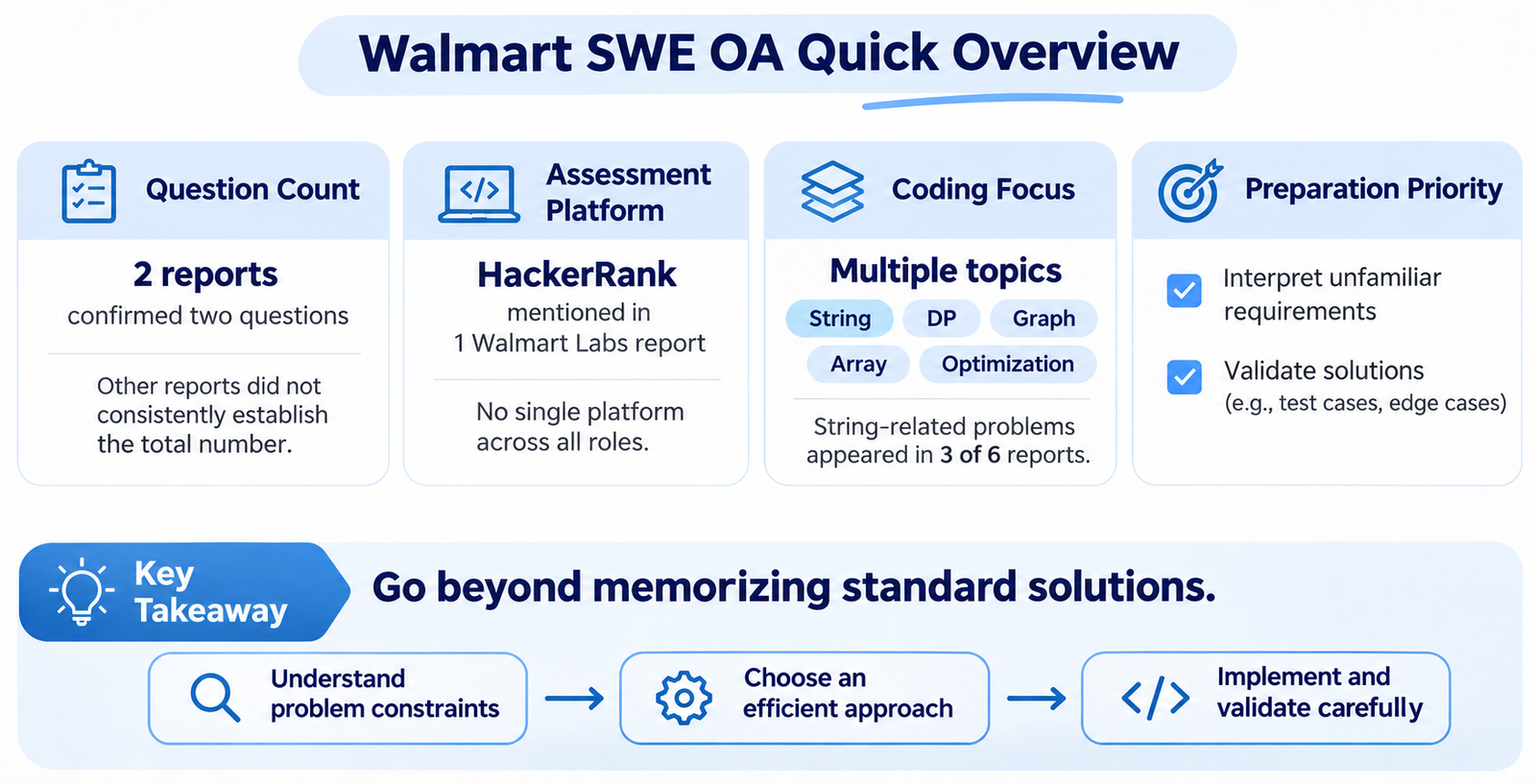
The most useful takeaway from these reports is that Walmart OA preparation should go beyond memorizing standard solutions. Candidates encountered problems that required adapting familiar algorithms to specific constraints, choosing between different approaches, and paying attention to implementation details.
- Question count: Two reports explicitly confirmed two coding questions. The remaining reports did not consistently establish the total number of questions.
- Assessment platform: HackerRank appeared in one Walmart Labs report, but the available experiences do not establish a single platform across roles.
- Coding focus: The reported questions span several algorithmic areas, with string-related constraints appearing in three of the six experiences.
- Preparation priority: Practice interpreting unfamiliar requirements and validating solutions, rather than relying only on recognizing common problem patterns.
The sections below examine the assessment format, real Walmart OA questions, common challenges, and practical ways to prepare.
2. Walmart Online Assessment Format for Software Engineers
Based on six Walmart SWE online assessment (OA) reports collected by Screna between April and July 2026, candidates described differences in question counts, assessment details, and coding topics. These reports reflect individual experiences rather than a standardized format across all Walmart software engineering roles.
How Many Questions Are on the Walmart OA? What Is the Pass Rate?
Of the six reports, two explicitly mentioned two coding questions, while four described only one question. However, only one of those four clearly identified the entire assessment as a single algorithmic problem. The other three did not confirm the total number of questions.
The table below summarizes the coding results and feedback shared in the six reports:
| Reported Coding Results and Candidate Feedback | Number of Reports |
|---|---|
| Passed all test cases for both coding questions | 1 |
| Passed two sample tests, with potential implementation issues | 1 |
| Reported a zero score following an implementation error | 1 |
| Was uncertain whether the solution was fully correct | 1 |
| Solution worked on small test cases, but optimality remained uncertain | 1 |
| Did not provide a clear test result | 1 |
| Total | 6 |
Two candidates also reported being rejected, while the candidate who passed all test cases did not confirm whether they advanced. Passing coding test cases is not necessarily equivalent to passing the overall assessment, so these reports do not provide enough information to calculate a reliable Walmart SWE OA pass rate.
Walmart OA Platform and Time Limit
HackerRank was explicitly mentioned in one Walmart Labs SWE OA report. The candidate described difficulties with input parsing, writing test cases, and formatting the required output. The other five reports did not identify an assessment platform.
The reports also did not establish a standard time limit. One candidate reported spending around 40 minutes on a string completion problem, with approximately 10 minutes left at that point. This illustrates the time pressure involved in that assessment without establishing a fixed duration for the Walmart OA.
What Types of Questions Appear on the Walmart OA?
The six Walmart SWE OA reports primarily involved algorithmic coding problems, covering string manipulation, dynamic programming, graph algorithms, arrays, and cost optimization.
| Coding Topic | Number of Reports | Reported Topics |
|---|---|---|
| String Manipulation | 3 | Digit frequency, string completion, palindrome and periodicity constraints |
| Dynamic Programming | 2 | DP-based string solution, partition DP |
| Graph Algorithms | 1 | Dijkstra, DFS, and backtracking |
| Arrays | 1 | Maximum contiguous subarray |
| Cost Optimization | 1 | Feature coverage and minimum-cost selection |
Some reports involved multiple algorithmic topics, so the category counts add up to more than six.
3. Real Walmart OA Coding Questions
The six Walmart SWE OA reports collected by Screna cover a range of coding topics, from string constraints and dynamic programming to optimization and graph algorithms. The examples below focus on the questions candidates encountered and the approaches documented in their experiences.
String Manipulation and Union-Find
String manipulation appeared in multiple Walmart OA questions, often with constraints beyond basic character processing. In a Walmart SWE OA report involving digit frequency constraints, the task was to remove digits from a numeric string while preserving the original order of the remaining digits. The goal was to construct the largest possible number in which every digit that appeared had an even frequency. The candidate explored a monotonic stack approach, making frequency tracking and subsequence construction central to the problem.
A different set of string constraints appeared in a Walmart online assessment involving palindrome and periodicity requirements. Candidates needed to find the minimum number of character changes required to make a string of length n both palindromic and k-periodic. A Union-Find approach can group positions that must contain identical characters, allowing the minimum changes to be calculated from character frequencies within each group.
String Completion and Minimum-Cost Optimization
One Walmart SWE OA coding experience featured a string completion task that asked for the minimum number of characters needed to make a given string valid. The candidate implemented a two-dimensional dynamic programming solution and later identified a potentially simpler two-pointer approach. The report did not fully specify the validity rules, so the exact problem constraints remain unclear.
Cost optimization also appeared in the Walmart software engineer online assessment. A Walmart OA report on minimum-cost model selection described n machine learning models, each with a cost and support for feature A, feature B, both, or neither. For each k from 1 to n, the task was to select models at the lowest total cost while ensuring that at least k selected models supported each feature. Models supporting both features counted toward both requirements, and an impossible configuration required an output of -1. The problem involved balancing the cost of dual-feature models against combinations of single-feature models. The candidate explored greedy selection and allocation strategies, although the report did not establish a verified optimal solution.
Array and Maximum Subarray Problems
A Walmart Labs HackerRank assessment report described a variation of the maximum subarray problem. Given an integer array, the task was to identify the contiguous subarray with the largest sum and return its starting and ending indices. The problem relates to Kadane's algorithm, with an additional requirement to track the subarray boundaries. Unlike versions that ask only for the maximum sum, this variation requires candidates to return the correct indices as part of the result.
Partition DP and Graph Algorithms
More advanced algorithm combinations appeared in a Walmart SWE internship OA report for the 2027 recruiting cycle. The assessment included two coding questions covering different algorithmic areas. The first involved Partition Dynamic Programming, requiring a DP-based approach to a partitioning problem. The second combined Dijkstra's algorithm, Depth-First Search (DFS), and backtracking, bringing multiple graph-related techniques into a single question.
4. Common Challenges in the Walmart SWE OA
The Walmart SWE OA reports highlight several challenges beyond understanding the algorithms, including choosing an efficient approach, avoiding implementation errors, and combining multiple techniques.
Time Pressure and Choosing an Approach
Finding an efficient solution can make a significant difference in a Walmart coding assessment. The string completion question illustrated how a dynamic programming approach could take considerable time to implement when a simpler alternative might be available. The minimum-cost model selection question presented a different challenge: balancing greedy strategies and model combinations while meeting feature coverage requirements. Both examples show why evaluating an approach before coding can be valuable, especially when implementation time is limited.
Implementation Bugs and Test Case Failures
Even when the overall algorithm is reasonable, implementation errors can affect the final result. In the palindrome and periodicity question, a Union-Find bug prevented the solution from working correctly and resulted in a reported score of zero. The digit frequency problem showed another risk: the candidate passed two sample tests, but potential issues with frequency updates and string handling remained. These experiences illustrate why passing visible test cases alone does not guarantee that a solution handles every input correctly.
Complex Algorithm Combinations
Some Walmart SWE OA questions required candidates to combine multiple algorithmic techniques rather than apply a single familiar solution. The 2027 internship assessment included a Partition DP question and another involving Dijkstra's algorithm, DFS, and backtracking. Such problems require candidates to understand how different techniques fit together, making problem decomposition and algorithm selection important parts of the process.
5. How to Prepare for the Walmart OA
Based on real Walmart SWE OA reports collected by Screna, preparation should focus on string manipulation, dynamic programming, graph algorithms, and optimization problems. Beyond reviewing these topics, candidates should practice selecting efficient approaches under time constraints and testing their implementations thoroughly.
Review Real Walmart Coding Questions
A useful starting point is the Screna Walmart interview questions and experiences collection, which brings together coding questions and assessment experiences shared by previous candidates. These reports highlight topics worth reviewing, including string constraints, Partition DP, Union-Find, and maximum subarray problems. Studying real Walmart OA questions alongside general algorithm practice can help candidates recognize how familiar concepts appear with different constraints in actual assessments.
Practice Relevant Algorithms Under Time Constraints
Knowing an algorithm does not always mean identifying the best approach quickly. During practice, set a time limit for solving string, DP, graph, and array problems. Before writing code, compare possible approaches, consider their time complexity, and choose a solution that is both efficient and practical to implement. For problems involving multiple constraints, spend time identifying which conditions must be satisfied before deciding on a strategy.
Test Edge Cases and Debug Your Code
Implementation details can be just as important as algorithm selection. Practice checking edge cases such as empty inputs, repeated characters, and extreme values rather than relying only on provided examples. Candidates can also use Screna AI Mock to practice explaining algorithm choices, discussing time complexity, and responding to technical follow-up questions. As a conversational interview preparation tool, AI Mock complements hands-on coding practice rather than replacing a timed Walmart coding assessment.
6. Walmart OA FAQ
The following answers are based on six Walmart SWE OA reports collected by Screna. Assessment formats may vary by role and recruiting cycle, so candidates should refer to their official Walmart assessment instructions for specific question counts, platforms, and testing requirements.
How Many Questions Are on the Walmart SWE OA?
Among the six Walmart SWE OA reports, two explicitly mentioned two coding questions, while four described only one question. However, only one of those four confirmed that the entire assessment consisted of a single problem. The available reports therefore do not establish a fixed question count for the Walmart OA.
Does Walmart Use HackerRank?
HackerRank has been used for Walmart SWE online assessments. One Walmart Labs OA report explicitly mentioned the platform, including requirements related to input parsing, coding, and output formatting. The other five reports did not specify an assessment platform.
What Types of Coding Questions Appear on the Walmart OA?
Reported Walmart OA questions include string manipulation, dynamic programming, Union-Find, arrays, cost optimization, and graph algorithms. Examples range from digit frequency constraints and maximum subarray problems to Partition DP and combinations of Dijkstra's algorithm, DFS, and backtracking. These topics provide a useful starting point for preparation, although they do not represent a complete or fixed question bank.
How Difficult Is the Walmart SWE OA?
Walmart SWE OA questions vary in complexity. Some build on familiar algorithms but introduce additional requirements, such as tracking subarray indices or satisfying multiple string constraints. Others involve more advanced techniques or combinations of algorithms. Performance depends not only on recognizing the underlying concepts but also on selecting an appropriate approach, implementing it correctly, and handling edge cases.