Interview Prep
8 IBM SWE OA Reports 2026: Real Questions & Debugging Tasks
Pian Yang · Marketing Specialist ·

Solving coding problems is only part of the challenge in an IBM Software Engineer online assessment. A candidate might pass every test case on the algorithm question and still struggle with the next task: debugging an unfamiliar application. Another might understand the code but run out of time navigating project files, reading documentation, or fixing failing tests.
These situations appeared in IBM SWE online assessment experiences shared on Screna in 2026. We reviewed eight candidate reports from June through August, covering entry-level, internship, and intermediate-level assessments. Together, they offer a closer look at what candidates actually encountered, where they lost time, and why conventional algorithm practice may not be enough.
This guide examines the reported IBM SWE OA format, real coding topics, repository debugging tasks, and preparation strategies based on those experiences. The findings reflect a limited set of candidate reports rather than IBM's official or universal assessment requirements.
1. IBM SWE OA Quick Overview
The most notable pattern in the eight IBM SWE OA reports was the combination of algorithm questions and practical software engineering tasks. Seven candidates described assessments that tested both coding fundamentals and the ability to work with an existing application. This distinction matters because a correct algorithm solution does not necessarily translate into success when the next task involves understanding unfamiliar code or troubleshooting an API.
Assessment structure and platform. All eight candidates reported two tasks, but the format was not identical across experiences. HackerRank was explicitly named in two reports, while only one candidate specified a 90-minute time limit. These details provide useful reference points without establishing a standard format for every IBM SWE applicant.
Coding questions and engineering work. The reported algorithm topics ranged from graph dependencies and dynamic programming to greedy approaches, heaps, and token expiration. Practical tasks introduced a different kind of challenge, including working with backend APIs, fixing failing tests, and understanding application behavior. Some candidates had to spend considerable time reading documentation before they could make meaningful progress.
What affected candidate performance. The reports suggest that time management and familiarity with real codebases can matter as much as algorithm knowledge. One candidate passed all algorithm tests but failed the repository debugging task. Another encountered TLE on a dynamic programming question, while a separate candidate reported breaking previously working code through a last-minute change.
What this means for preparation. Candidates can use these experiences to understand the range of skills that appeared in the collected assessments. Alongside algorithm practice, becoming comfortable reading existing projects, investigating test failures, and verifying code changes may help address the challenges described in the reports. The sections below examine these experiences in more detail.
2. IBM Coding Assessment Format
According to IBM's official application process, coding assessments may include multiple-choice questions or programming challenges, depending on the role. In seven of the eight IBM SWE OA reports collected by Screna between June and August 2026, candidates encountered an algorithm question followed by a practical engineering task, such as debugging an existing codebase or implementing API routes. The remaining report described two algorithm questions.
How Many Questions Are on the IBM SWE OA, and How Long Is It?
All eight reports describe assessments with two tasks, although the combination varies. Several entry-level and internship candidates encountered an algorithm problem followed by a practical engineering task. In contrast, a July 2026 IBM SWE OA report described two algorithm questions involving greedy and heap approaches. The same candidate reported a 90-minute assessment. The other seven reports did not specify an overall duration, so the available experiences do not establish a fixed time limit. The workload also varied, with some candidates completing both tasks while others ran out of time before finishing.
Does IBM Use HackerRank for Coding Assessments?
HackerRank was explicitly mentioned in two of the eight reports. An IBM SWE intern candidate completed a HackerRank assessment involving a conventional coding question and an API route implementation task in an IDE. Another entry-level SWE candidate reported using HackerRank for an assessment that included an algorithm problem and debugging an existing application. Unlike standalone coding problems, some practical tasks required candidates to navigate existing project files, understand application logic, and verify changes through tests. The remaining reports did not identify the assessment platform.
3. Real IBM SWE OA Questions and Tasks
The eight IBM SWE OA reports collected by Screna between June and August 2026 covered several algorithm categories, including graph and dependency problems, dynamic programming, greedy algorithms, heaps, and token expiration. Some topics appeared in multiple reports, while others were mentioned only once. Since the candidate notes do not always include complete problem statements, the following sections focus on reported question types and recurring concepts rather than reconstructing exact questions.
Graph and Dependency Questions
Graph and dependency problems appeared in two IBM entry-level SWE OA reports from July and August 2026. The July IBM SWE OA experience and August report both described questions involving graph traversal, relationships between elements, and dependency ordering. Although the reports do not establish whether the exact questions were identical, they show that graph and dependency concepts appeared more than once in the collected assessments, making them relevant concepts for candidates to understand.
Dynamic Programming, Greedy, and Heap Questions
Dynamic programming, greedy algorithms, and heaps also appeared in the reported IBM SWE assessments. A July 2026 intermediate-level SWE experience included a dynamic programming problem, while the 90-minute assessment discussed earlier featured two algorithm questions involving greedy and heap approaches.
These categories involve different techniques. Dynamic programming uses previously computed results to solve overlapping subproblems, greedy algorithms make locally optimal choices, and heap-based approaches use priority queues to manage elements efficiently.
Token Expiration and Other Reported Problems
Token expiration was another reported coding topic. The entry-level HackerRank assessment mentioned in Chapter 2 included a question involving token validity and expiration timestamps, with particular attention to time-related boundary conditions.
Other candidates described standard algorithm questions without providing detailed requirements. Taken together, the reports suggest that IBM SWE OA preparation should cover several algorithm fundamentals rather than focus on a single question type.
4. IBM Repository Debugging and API Implementation
Practical engineering tasks appeared in seven of the eight IBM SWE OA reports. Unlike standalone algorithm problems, these tasks required candidates to debug existing applications or implement API functionality. An August 2026 IBM SWE OA experience described an algorithm question followed by repository debugging, illustrating this combination. Other reported tasks covered backend API debugging, caching, Django applications, and API route implementation.
Fixing API Filtering, Pagination, and Cache Bugs
API debugging appeared in multiple IBM SWE OA reports. The July and August entry-level experiences discussed in Chapter 3 both described backend debugging tasks involving API filtering, pagination, and Redis caching. Candidates needed to understand existing application logic, investigate failing tests, and correct issues affecting API behavior. Cache invalidation and pagination edge cases were among the reported areas of focus, making these tasks closer to everyday backend troubleshooting than standalone algorithm problems.
Debugging a Django Backend
The intermediate-level SWE assessment mentioned in Chapter 3 also included a Django backend debugging task. The candidate had to navigate an unfamiliar application and work through extensive documentation to understand the requirements, but did not complete the task. This experience highlights the importance of reading project specifications and understanding existing code under time pressure. Django appeared in this assessment, although the reports do not establish it as a standard framework for IBM SWE OAs.
Implementing API Routes in an IDE
The IBM SWE intern HackerRank experience introduced in Chapter 2 included an API route implementation task in an IDE alongside a conventional algorithm question. The candidate needed to build the required API functionality rather than troubleshoot an existing application. They passed the assessment and received an invitation to a competency interview the following day.
These experiences show why familiarity with existing backend projects and API development can be valuable alongside algorithm preparation.
5. Why Candidates Struggled with the IBM SWE OA
The IBM SWE OA reports highlight challenges beyond algorithm difficulty. Some candidates performed well on coding questions but struggled with practical engineering tasks, while others faced time pressure or encountered problems after making last-minute changes.
Passing Algorithm Tests but Struggling with Debugging
In a June 2026 IBM SWE intern OA report, the candidate passed every test case for the algorithm question but failed all tests in the repository debugging task. With limited hands-on development experience, they found it difficult to navigate a large, unfamiliar codebase and identify the underlying issues. This illustrates how solving standalone coding problems and troubleshooting an existing application can require different skills.
Time Pressure, Documentation, and TLE
Time pressure affected both algorithm and engineering tasks. The July intermediate-level SWE candidate passed most tests on a dynamic programming problem but encountered Time Limit Exceeded (TLE). Extensive documentation for the subsequent Django debugging task added to the workload, and the candidate could not finish the assessment. The July entry-level candidate who encountered a graph and dependency problem also reported completing the backend debugging task with roughly 90 seconds remaining. These experiences show how understanding requirements, navigating unfamiliar code, and verifying changes can consume a substantial portion of the available time.
Last-Minute Code Changes and Submission Risks
The entry-level HackerRank candidate discussed earlier reported that a last-minute optimization attempt broke code in the API debugging task that had previously passed most tests. With insufficient time to restore the working version, the candidate was unsure which version had been saved or submitted. This highlights the risk of making unverified changes near the end of a timed assessment.
6. How to Prepare for the IBM SWE OA
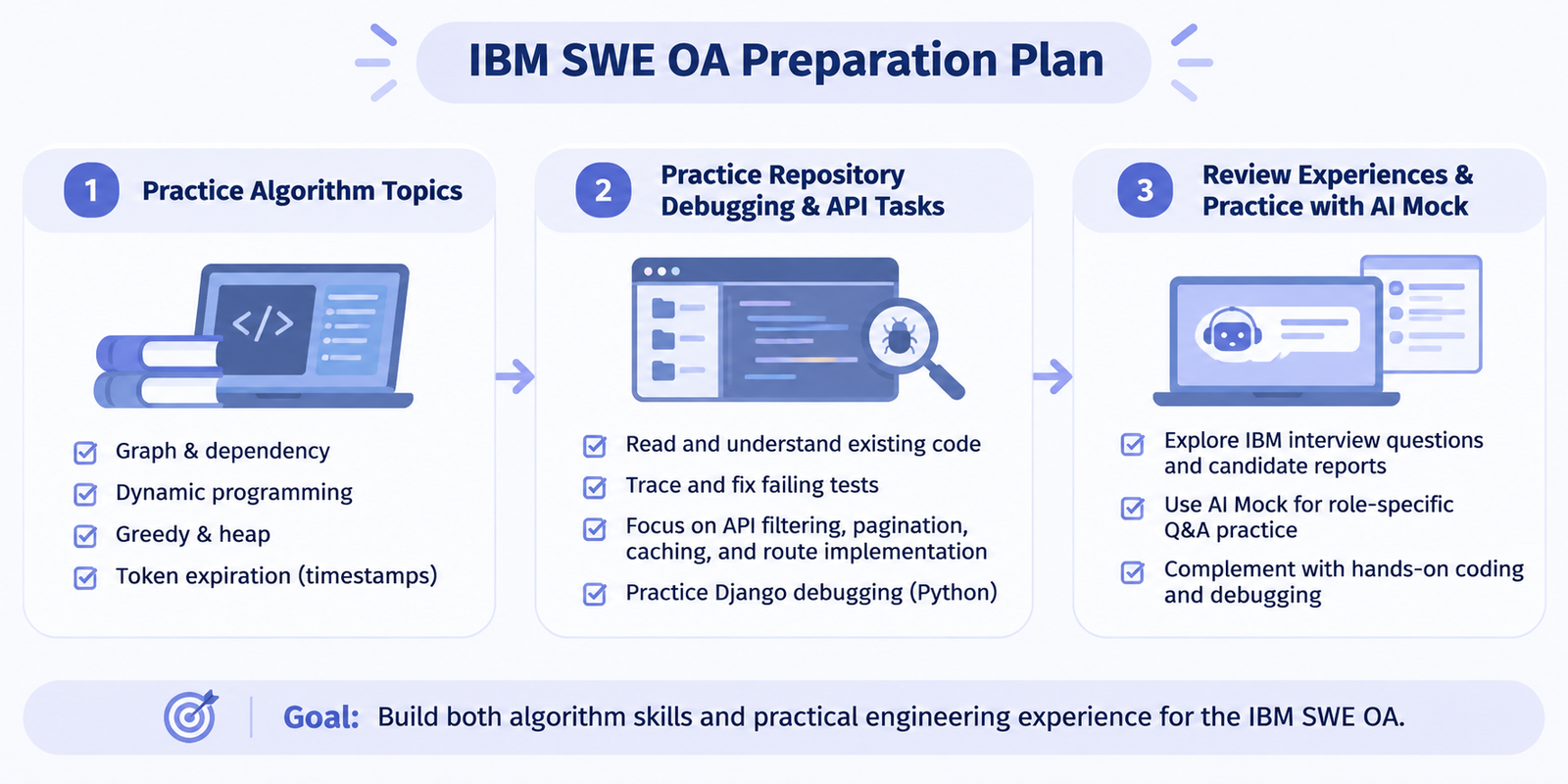
Based on the reported IBM SWE assessments, preparation should go beyond traditional algorithm practice. Candidates should also become comfortable debugging existing applications and implementing basic backend API functionality. The following strategies focus on the question types and engineering tasks described in the collected experiences.
Practice the Reported Algorithm Categories
Start with graph traversal and dependency ordering, which appeared in multiple reports. Dynamic programming, greedy algorithms, and heaps are also worth reviewing, along with timestamp-based problems such as token expiration. Practice identifying the appropriate approach and checking boundary conditions, especially when expiration timestamps match the current time. Focus on understanding the underlying techniques rather than memorizing individual solutions.
Practice Repository Debugging and API Tasks
Use an unfamiliar backend project to practice reading existing code, tracing failing tests, and making targeted fixes. The reported IBM tasks provide useful areas to focus on, particularly API filtering, pagination, caching, and route implementation. Python developers can also practice debugging Django applications. Working under a time limit can help build familiarity with the process of understanding requirements, making changes, and verifying results before submission.
Review IBM Interview Experiences and Practice with AI Mock
The Screna IBM interview questions and experiences library provides candidate reports across different roles and experience levels, helping applicants explore assessment topics and later interview stages. For technical interview preparation, Screna's AI Mock can generate role-specific questions based on a target position and job description. Candidates can use these question-and-answer sessions to practice explaining technical concepts, project experience, and problem-solving approaches. Since AI Mock does not replicate a live coding environment, it works best as a complement to hands-on algorithm and debugging practice.