Interview Prep
15 Capital One OA Reports 2026: CodeSignal Questions & Examples
Pian Yang · Marketing Specialist ·

Preparing for the Capital One coding assessment in 2026? Finding reliable, recent OA questions isn't always easy. Experiences shared across different platforms can be scattered, incomplete, or difficult to compare. To make that information easier to navigate, we reviewed 15 Capital One online assessment reports from April to October 2026, covering Software Engineering, Machine Learning Engineering, Data Science, and Data Analytics roles.
Rather than relying on a single interview experience, this guide brings together firsthand accounts to give you a broader view of Capital One CodeSignal questions, assessment patterns, and what to expect when preparing for the OA.
1. Capital One OA 2026: Quick Answer
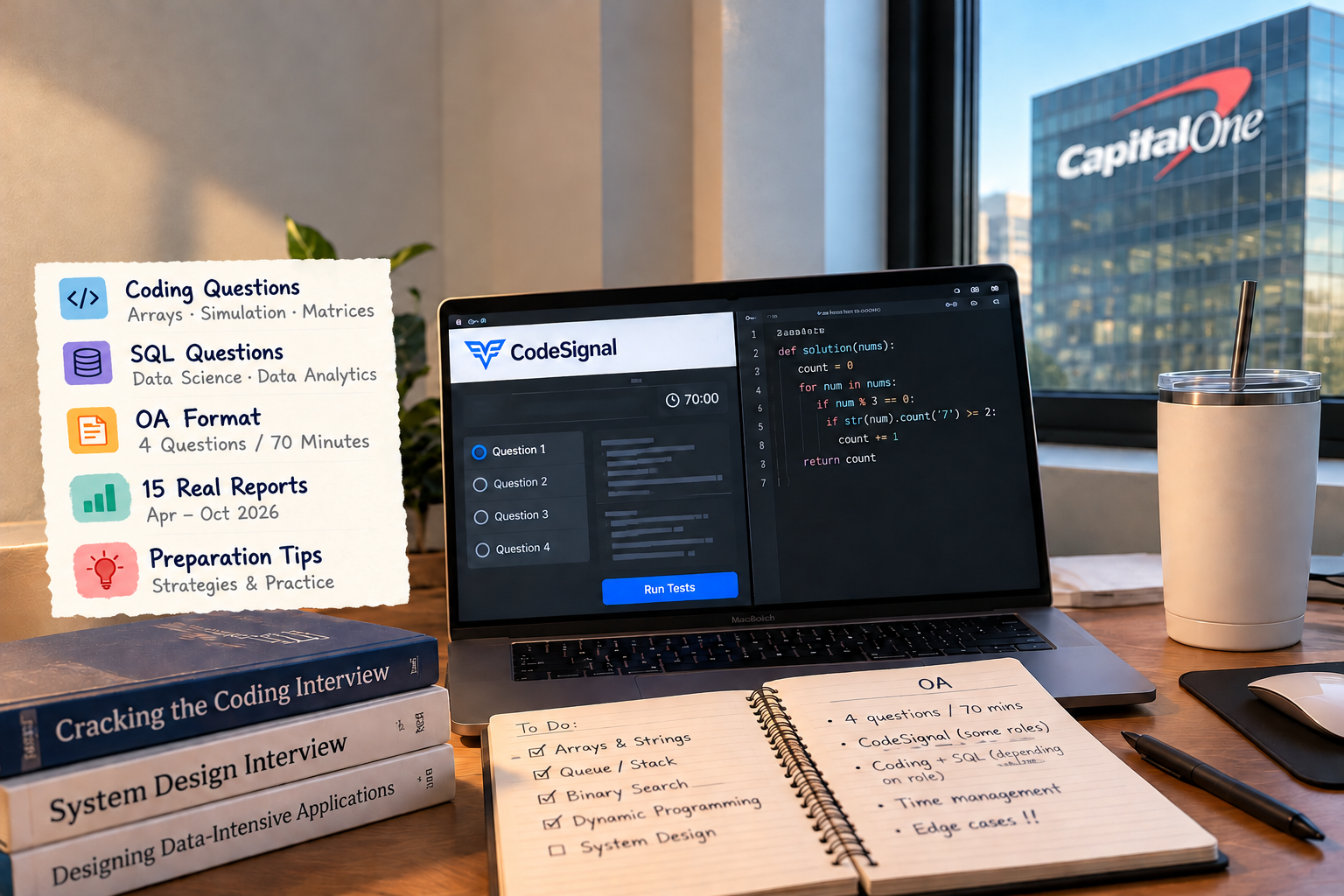
Capital One uses CodeSignal for some technical online assessments, but the format varies by role. A commonly reported format is four coding questions in 70 minutes, although this isn't guaranteed for every position.
Based on 15 Capital One OA reports from April to October 2026, reported questions include array manipulation, queue-based simulations, matrix partitioning, interval queries, and grid problems. Data Science and Data Analytics assessments have also included SQL questions.
The biggest challenges are often time management, hidden test cases, and writing efficient solutions. This guide breaks down real Capital One CodeSignal questions, their approaches, and practical preparation strategies.
2. Capital One Online Assessment 2026: Format & Overview
The Capital One Online Assessment isn't the same for every role. If you're applying for a technical position, you may face coding challenges, while other roles may involve data-related tasks or workplace assessments.
1. Capital One Online Assessment Types by Role
Based on Capital One's official careers guidance and recent candidate reports, here are the main assessment formats you might encounter:
- Coding Assessments: Capital One's AI/ML hiring guidance outlines a 70-minute assessment with four data structures and algorithms questions.
- Data-Focused Assessments: Candidates applying for Data Science and Data Analytics roles have encountered SQL queries and other data-related problems.
- Virtual Job Tryout (VJT): According to Capital One's official FAQ, this assessment covers workplace scenarios, business cases, and questions about your experience and work style.
These aren't three required stages of the hiring process. What you actually take depends on the role you're applying for.
2. Does Capital One Use CodeSignal?
Yes, Capital One uses CodeSignal for some technical roles. The platform appears in Capital One's official AI/ML recruitment guidance, and Software Engineering candidates have also shared experiences taking coding assessments on CodeSignal. In one Capital One CodeSignal assessment, a candidate faced four questions covering arrays, queue simulation, matrix partitioning, and interval coverage. Another candidate struggled with time pressure and couldn't pass every test case. That said, not every Capital One Online Assessment uses CodeSignal, and the questions can vary depending on the role.
3. How Many Questions Are on the Capital One OA, and How Long Does It Take?
Four questions in 70 minutes is a common format in the available reports, but it's not guaranteed for every role. Capital One's official AI/ML hiring guidance describes this format, and a Senior Software Engineer candidate reported the same experience. Looking at 15 Capital One OA reports from April to October 2026, several candidates mentioned four-question assessments, while others shared only some of the problems they encountered. So if you're preparing for the Capital One OA, check your assessment invitation for the exact question count and time limit.
3. Real Capital One CodeSignal Questions
In an August 2026 Capital One CodeSignal assessment, a Front End Engineer candidate encountered four coding problems covering number manipulation, queue simulation, matrix optimization, and interval queries. The candidate found the first question relatively approachable and shared detailed notes about their Capital One CodeSignal assessment experience. The four questions below represent one reported question set, and other candidates may encounter different sets.
Here's a quick overview of the four reported questions:
| Question | Topic | Key Skills |
|---|---|---|
| Q1. Array and Digit Counting | Arrays and numbers | Iteration, divisibility, digit counting |
| Q2. Queue-Based Card Game Simulation | Simulation | Queues, state tracking |
| Q3. Matrix Partitioning and Optimization | Matrices | Prefix sums, optimization |
| Q4. Interval Coverage and Efficient Queries | Intervals | Sorting, binary search |
Question 1: Array and Digit Counting
Problem: Given an array of integers, count how many numbers are divisible by 3 and contain the digit 7 at least twice.
Approach: Iterate through the array, check divisibility by 3, and count occurrences of 7 in each number's string representation. Both conditions must be satisfied.
Question 2: Queue-Based Card Game Simulation
Problem: Simulate a two-player card game where the top card from each deck determines the winner of each round. Return the total number of rounds played until either deck becomes empty.
Approach: Use two queues to represent the decks. Process each round, update the game state according to the rules, and count rounds until one queue is empty.
Question 3: Matrix Partitioning and Optimization
Problem: Given a matrix of integers, choose one horizontal cut and one vertical cut to divide it into four regions. Each region must contain at least one nonnegative value. Calculate the floor of the average of nonnegative values in each region, then minimize the difference between the highest and lowest averages.
Approach: Try valid row and column cuts. Use 2D prefix sums to calculate regional sums and counts efficiently, then compare the four averages.
Question 4: Interval Coverage and Efficient Queries
Problem: Given multiple lamps, each covering an interval, determine how many lamps illuminate each query position.
Approach: Sort the interval start and end points. Use binary search to count how many intervals cover each query position without checking every lamp individually.
4. Other Capital One OA Questions and Examples
Beyond the four CodeSignal questions above, recent Capital One OA reports include a variety of coding challenges, from bubble-popping simulations and dynamic obstacle queries to string manipulation and SQL problems.
1. Grid and Simulation Questions
Some problems involve placing shapes on a grid or simulating how bubbles fall after being popped. One Capital One grid simulation interview experience described a bubble-popping problem involving gravity, while another candidate encountered a question about how infection spreads between neighboring plants. The rules may seem straightforward, but the order of updates and boundary conditions can make these simulations tricky.
2. Dynamic Range and Obstacle Queries
A Capital One dynamic obstacle query interview experience involved inserting walls at different positions and checking whether a segment of a given length could fit within a range. Another problem used a segment tree to find available space. The challenge isn't just determining whether a range meets the requirements, but avoiding a full scan after every update.
3. Array and String Manipulation Questions
Other examples include counting integers with an even number of digits, reversing a prefix or suffix to produce the lexicographically smallest string, and using a hash map to count matching pairs. These problems rely on familiar algorithms, but edge cases and time complexity still matter.
4. SQL Questions for Data Roles
Capital One's Data Science and Data Analytics OA reports include both SQL and algorithmic questions, depending on the assessment. One Capital One SQL assessment experience involved finding each user's longest streak of consecutive days with successful transactions, excluding failed and canceled transactions, and sorting the results by streak length in descending order. Another problem asked candidates to find the minimum purchase price by category under specific rating conditions. These questions require a solid understanding of SQL grouping, filtering, and conditional logic.
5. How Difficult Is the Capital One Online Assessment?
The hardest part of the Capital One OA isn't necessarily understanding the questions. It's getting working solutions within the time limit, especially when later problems involve more complex algorithms.
1. Time Pressure and Incomplete Solutions
With four questions in 70 minutes, there's limited time to solve, debug, and test each problem. The difficulty isn't evenly distributed, either. A Capital One CodeSignal assessment experience highlighted how time pressure can leave questions incomplete. Spending too long on an early problem can leave little room for the more demanding problems toward the end.
Recent candidate reports also show how results can vary. One Capital One Lead SWE assessment experience reported a score of 548/600 after completing three of four questions, with one solution failing to meet the required time complexity. The candidate was ultimately rejected. Another Capital One Staff SWE CodeSignal experience reported 347/600, with the application outcome still pending at the time of the report.
2. Hidden Test Cases and Time Limit Exceeded
Code that passes the sample inputs can still fail on larger datasets or unexpected edge cases. Time Limit Exceeded (TLE) was among the issues described in a Capital One Senior Software Engineer OA experience. A solution might produce the correct output but still fail because it takes too long to run.
3. Why Algorithm Optimization Matters
Consider an interval coverage problem: checking every interval for every query is simple to implement, but sorting the endpoints and using binary search can make repeated queries much faster. Matrix problems offer a similar trade-off. Instead of recalculating sums for every possible partition, 2D prefix sums let you reuse earlier calculations.
These optimizations matter most when the basic solution works but can't handle the full input size.
6. How to Prepare for the Capital One OA and CodeSignal
A useful starting point is to turn the Capital One questions covered above into a focused practice set. Rather than memorizing solutions, work through each problem and identify the algorithm behind it.
1. Practice the Coding Patterns Found in Candidate Reports
Start with the queue-based card game, matrix partitioning, and interval coverage problems. Try solving each one independently, then review the approach and identify where your implementation could be improved. You can find more company-specific examples in Screna's Capital One interview question library.
2. Test Edge Cases and Improve Time Complexity
For interval coverage, test overlapping ranges and boundary positions. For matrix partitioning, check cuts that leave a region without nonnegative values. Compare your initial solution with a more efficient approach using binary search or prefix sums.
3. Build a Timed Practice Routine
If your invitation specifies four questions in 70 minutes, use that format for a practice session. Review unfinished problems afterward and identify whether the difficulty came from algorithm selection, implementation, or testing. To practice explaining your reasoning, you can also use Screna AI Mock with a relevant role and job description.
7. Capital One OA and CodeSignal FAQ
1. Are Capital One OA Questions the Same for Every Role?
No. Software Engineering assessments may include coding problems involving arrays, simulations, and algorithms, while Data Science and Data Analytics candidates have also encountered SQL questions. The format and question selection vary by role, so the examples in this guide should be treated as preparation references rather than a fixed question set.
2. Is There a Passing Score for the Capital One CodeSignal Assessment?
Capital One has not publicly disclosed a universal CodeSignal passing score. Candidate reports show different scores and outcomes: one Lead SWE candidate scored 548/600 and was rejected, while a Staff SWE candidate reported 347/600 with the outcome still pending. These individual results do not establish an official cutoff, so a particular score cannot guarantee whether a candidate will advance.
3. What Happens After the Capital One Online Assessment?
The next steps depend on the role and where the assessment falls in the hiring process. According to Capital One's official interview guide, candidates who advance may go through a hiring manager interview or Power Day, which can include behavioral, job-fit, and case interviews. Data Science candidates complete a take-home challenge before Power Day. There is no single interview sequence that applies to every CodeSignal assessment. You can check your application status through the Capital One candidate portal and follow any instructions from your recruiter.