Interview Prep
13 Anthropic OA Reports 2026: Progressive Coding Questions
Pian Yang · Marketing Specialist ·
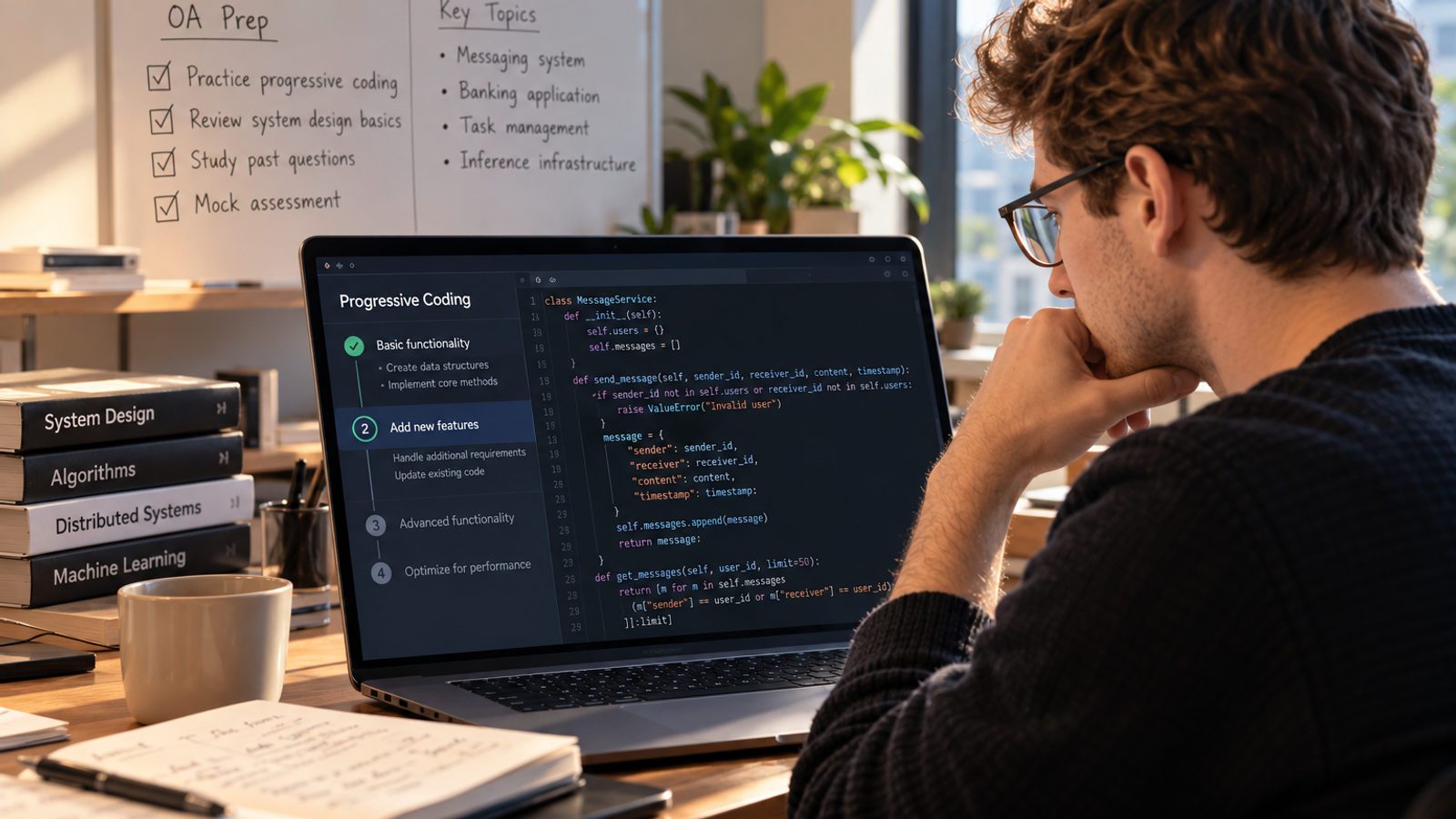
From messaging systems and banking applications to consistent hashing for GPU inference, the questions reported in Anthropic's 2026 online assessments cover a wide range of technical topics. Some require candidates to build on the same codebase across multiple levels, while others focus on standalone algorithms or specialized engineering knowledge. Traditional algorithm practice alone may not cover all these assessment formats.
Screna reviewed 13 candidate-reported Anthropic OA experiences from April to September 2026 to examine the actual questions, assessment formats, and preparation priorities. All reported questions, scores, durations, and outcomes reflect individual candidate experiences rather than official Anthropic standards. Preparation recommendations are based on editorial analysis, while platform-specific information is referenced separately from official documentation.
1. Anthropic Online Assessment 2026: Quick Overview
The Anthropic online assessment can involve progressive coding, where candidates implement and extend a system across multiple levels, or a standalone technical problem. The format varies across reported experiences, so preparation should account for both multi-stage implementation and the technical requirements of the target role.
| Question | Quick Answer |
|---|---|
| What is the Anthropic OA format? | Reported formats include progressive coding, standalone coding, and specialized technical assessments. |
| What does progressive coding involve? | Building a working system and extending it as additional requirements are introduced. |
| What topics appear in candidate reports? | Messaging, banking, recipe management, task management, account merging, and inference infrastructure. |
| Is CodeSignal used? | Yes, in some reported assessments, but it is not the only format described. |
| What skills matter most? | Implementation accuracy, managing changing requirements, debugging, and role-specific technical knowledge. |
| How should candidates prepare? | Combine timed implementation exercises with practice tailored to the target position. |
Key Findings From 13 Anthropic OA Reports on Screna
The most useful insight from the 13 reports is not a single question that candidates should memorize. It is the range of technical work candidates were asked to complete and the different ways their implementations were evaluated.
- Progressive coding rewards the ability to maintain and extend working code. Several reports described assessments in which the initial implementation was only the starting point. Later stages required candidates to work with existing decisions rather than begin again with a clean solution.
- Similar problem themes do not guarantee identical requirements. Messaging and banking systems appeared in multiple reports, but the specific functionality and constraints differed. Recognizing a problem category may help candidates prepare, yet the precise rules still determine the implementation.
- Some assessments emphasize specialized engineering knowledge. The Fellows and AI Safety Fellow experiences involved working with an existing project or applying infrastructure concepts to a technical scenario. These formats call for preparation beyond general algorithm practice.
- Some reported questions resemble previously available practice problems. Three candidates described recognizable questions, publicly available challenges, or similarities to problems they had practiced. Reviewing known question types may therefore be a useful starting point for preparation.
2. Anthropic Progressive Coding Assessment: Format and Real Questions
How the Progressive Coding Assessment Works
(1) CodeSignal and Progressive Coding Format
Anthropic's progressive coding assessments involve building a small system and extending it as new requirements are introduced. Instead of solving several unrelated algorithm problems, candidates work with the same codebase across multiple stages. Reported scenarios include messaging services, banking systems, recipe management, and task management applications.
Among the 13 candidate reports reviewed, three explicitly described a CodeSignal assessment, while another three characterized the format as CodeSignal-style. CodeSignal's official documentation on progressive coding questions explains how requirements can be introduced in stages.
(2) How Progressive Coding Levels Build on Each Other
Several candidate experiences describe multi-level coding problems in which each stage introduces new functionality. Later requirements may involve more complex queries, changes to existing data, or performance constraints.
| Stage | Common Requirements | Examples From Candidate Reports |
|---|---|---|
| Early stages | Basic operations and data storage | Creating accounts, storing messages, registering recipes |
| Feature expansion | Additional operations and queries | Direct messaging, channel management, searching and sorting |
| Advanced functionality | More complex business rules | Message expiration, scheduled payments, historical records |
| Later-stage requirements | Complex state queries or performance constraints | Historical balance queries, time and memory optimization |
ChatBox Service and Messaging System
Real Features Reported Across Levels
ChatBox appeared in three candidate reports covering different stages of a messaging system. The tasks progressed from basic message operations to more complex features and performance requirements.
An Anthropic online assessment report on the ChatBox system described Level 2 requirements involving direct messaging, channel membership, and message history queries. The Level 3 coding assessment experience covered message expiration, notifications, and user filtering, while the ChatBox Level 4 questions introduced stricter time and memory constraints.
Together, these reports show how progressive coding assessments can require changes to both functionality and data organization as new requirements are introduced.
Banking System With Progressive Features
(1) Account Operations and Scheduled Payments
The banking system questions focused on account states and transaction records. An Anthropic progressive coding interview experience described account creation, deposits, withdrawals, scheduled payments, cashback, and partial transfers. Basic account operations formed the foundation, while subsequent features introduced transactions that depended on timing and account history.
(2) Account Merging and Historical Balances
A banking system online assessment report covered account merging and historical balance queries. The getBalance() function needed to return the correct balance for a specified timestamp rather than the current balance. The problem also required handling reused account IDs, ensuring that a newly created account did not inherit the balance history of an account that had previously been merged.
These requirements made tracking separate account lifecycles particularly important. The candidate also noted that the assessment closely resembled a problem they had practiced before, suggesting that familiarity with similar questions may help candidates recognize the underlying problem structure.
Recipe Service and Recipe Manager
Recipe Registration, Ratings, and Queries
Recipe-related questions involved registering recipes, managing ratings, and retrieving stored information. An Anthropic online coding assessment report described requirements involving recipe owners, names, timestamps, ingredients, and preparation steps. The system also needed to handle duplicate entries, missing records, and case-insensitive name searches.
The candidate noted uncertainty about the expected return values for successful operations, duplicates, and missing records, and chose string-based status codes in their implementation. These return values reflect the candidate's approach rather than a confirmed requirement of the assessment.
A separate Recipe Manager assessment experience involved a similar management-system problem. The candidate suggested that the assessment drew from a relatively small pool of recognizable questions and that practicing known problems could make many of them familiar. The candidate reported a perfect score and a passing result, although the report does not establish that the two Recipe assessments had identical requirements.
Task and Worker Management Systems
(1) Task Management: CRUD, Assignment, Quotas, and History
An Anthropic task management coding question involved progressively extending basic create, read, update, and delete operations with sorting, task assignment, user quotas, and historical queries.
The challenge was maintaining consistent task states as new requirements were introduced. Candidates needed to account for how updates, assignments, and quotas could affect existing records and subsequent queries.
(2) Worker Management: Promotions, Sessions, and Salary Grants
A worker management progressive coding experience covered employee promotions, office entry and exit records, work sessions, and salary grant rules. Promotions became effective upon an employee's next office entry, while salary grants applied only when they fully covered a work session. Overlapping grants did not need to be merged.
Compared with Task Management, this problem placed greater emphasis on event timing, state transitions, and work intervals. The candidate also reported that the question came from a publicly available hiring challenge and achieved a perfect score with a passing result. This suggests that reviewing known problems could be useful preparation, although a single outcome cannot establish its impact on assessment performance.
3. Other Anthropic OA Formats and Real Questions
Standalone Coding: Account Merging
Problem Format and Requirements
Not every Anthropic online assessment followed a progressive coding format. An Anthropic software engineer online assessment involved identifying related accounts through shared email addresses and merging accounts belonging to the same user.
The reported problem can be approached using union-find or graph traversal to identify transitive connections between accounts. These are suggested solution strategies, not methods the candidate reported being required to use.
Unlike progressive coding tasks, the account-merging problem focused on solving one complete problem instead of continuously extending a system through multiple feature levels.
Anthropic Fellows: Starter-Code Implementation
Starter Code, README, and Implementation Requirements
An Anthropic Fellows coding assessment experience described an algorithm implementation task based on an existing codebase and README instructions. Rather than starting from an empty file, the candidate needed to understand the project structure, follow the documented requirements, and complete the implementation within the provided interfaces.
AI Safety Fellow: Consistent Hashing for GPU Inference
(1) Consistent Hashing and Virtual Nodes
An Anthropic AI Safety Fellow interview experience involved consistent hashing and virtual nodes in a GPU inference environment. The problem required applying these concepts to request routing rather than simply explaining how consistent hashing works.
The reported requirements also considered how the system should behave when servers were added or removed. This introduced questions about how requests would be redistributed as the available infrastructure changed.
(2) GPU Routing, KV Cache Locality, and Tail Latency
Request routing in this scenario needed to account for KV cache locality, cache reuse, and load balancing across GPUs. The system also had to consider tail latency, since uneven request distribution or poor cache locality could affect the performance of slower requests.
This was a specialized AI infrastructure problem with a different technical focus from the management-system coding tasks reported by software engineering candidates.
4. Common Challenges in the Anthropic Online Assessment
Challenges in Progressive Coding Assessments
(1) Time Pressure Across Multiple Levels
Time pressure in progressive coding assessments comes from the accumulation of requirements. The ChatBox Level 3 and Task Management cases highlight how time spent debugging early functionality can limit progress on later stages.
Candidates need to decide how much time to spend refining an existing feature before moving on to the next requirement. Finishing the basic operations is only one part of the assessment; the remaining time must also cover integration and testing.
(2) Extending Code Without Breaking Earlier Features
The ChatBox Level 2 and Banking System cases illustrate a common problem: an implementation that works for the initial requirements may become difficult to maintain as new features are added.
Early decisions about data structures and state management can affect later development. Candidates need to balance implementation speed with enough flexibility to support additional operations without repeatedly rewriting core functionality.
(3) Complex State Changes and Edge Cases
The Banking System, Recipe Service, and Worker Management cases demonstrate how edge cases become more difficult when multiple rules interact. Problems involving historical states, missing records, and event timing require more than checking whether individual functions work.
Candidates must also consider how operations affect one another and whether the system behaves consistently after a sequence of changes.
(4) Performance Constraints in Later Levels
The ChatBox Level 4 experience highlights another challenge: functional correctness may not be sufficient when later stages introduce stricter performance requirements. Candidates may need to revisit earlier design decisions and evaluate whether their implementation can handle larger workloads or more demanding queries.
Challenges in Other OA Formats
(1) Standalone Coding: Account Merging Edge Cases
The standalone Account Merging problem requires recognizing relationships that extend beyond direct connections. The challenge is to identify complete groups correctly while handling independent accounts and overlapping relationships.
Unlike multi-level coding tasks, the difficulty is concentrated in solving one problem thoroughly.
(2) Fellows: Conflicting Starter-Code Requirements
The Fellows starter-code case highlights the difficulty of working with an existing project when documentation and implementation details do not align.
Candidates must interpret the available information, understand the intended interfaces, and decide how to proceed without breaking the surrounding code.
(3) AI Safety Fellow: Applying Infrastructure Concepts
The AI Safety Fellow problem required connecting algorithmic concepts with practical infrastructure concerns. Request routing decisions can affect cache reuse, load distribution, and latency, especially when the available servers change.
The challenge lies in reasoning about how these factors interact within a real system rather than treating each concept independently.
5. How to Prepare for the Anthropic Online Assessment
Preparing for Progressive Coding Assessments
(1) Practice Known Anthropic OA Questions First
Three of the 13 candidate reports described questions that were recognizable, publicly available, or similar to previously practiced problems. Two of these candidates reported perfect scores and passing results. While this does not establish a higher pass rate, it suggests that practicing known question types may be a useful preparation strategy. Start with previously reported Anthropic interview questions on Screna. Focus on understanding the requirements and solving variations rather than memorizing answers.
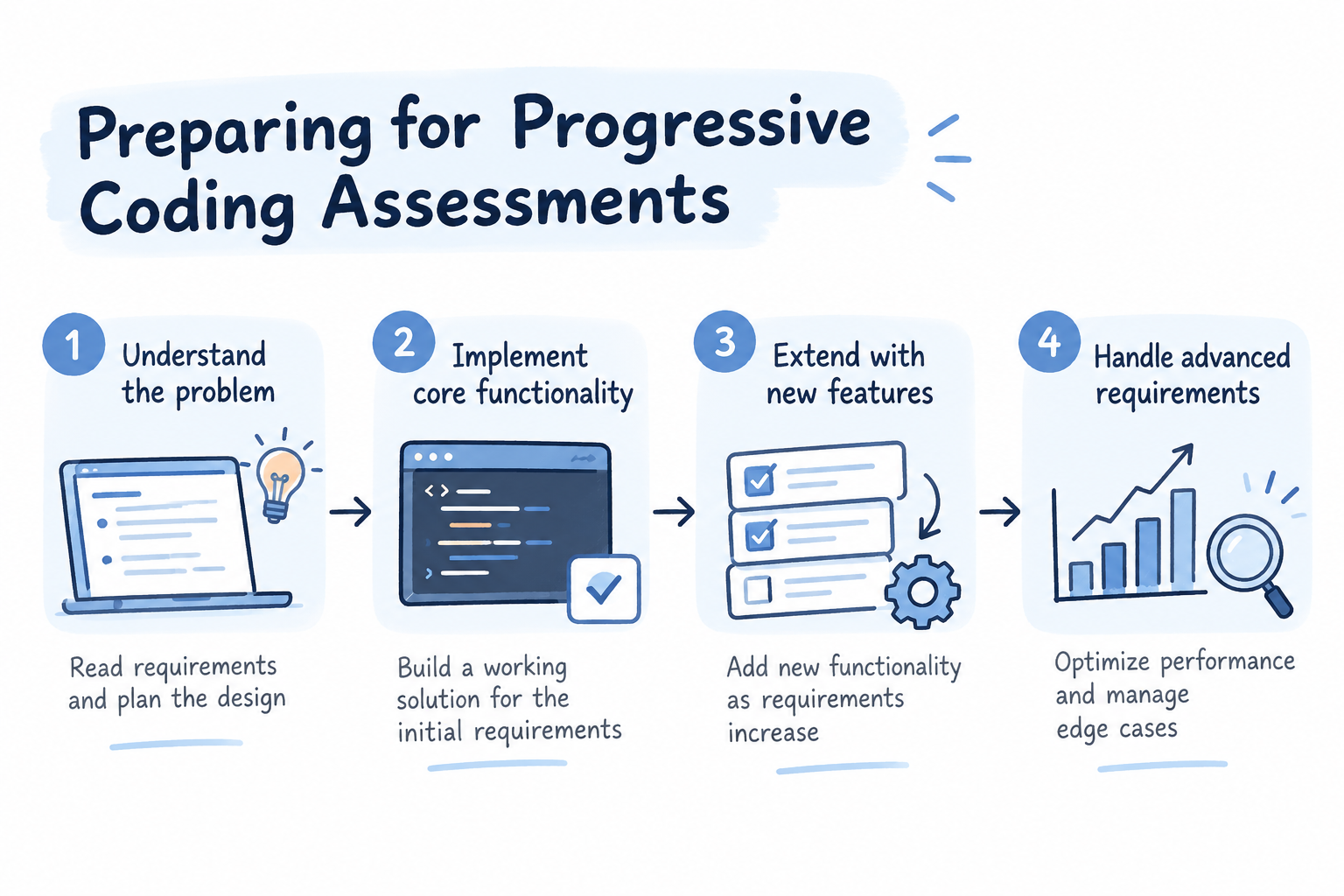
(2) Practice Multi-Level Feature Implementation
Practice building a small application across multiple stages, from basic operations to more complex features and state changes.
Introduce new requirements one stage at a time while continuing to work with the same codebase. This helps simulate the progressive coding format described in several Anthropic OA reports.
(3) Design Extensible Data Structures
Choose data structures that support future changes without requiring major rewrites. Pay particular attention to historical records, state transitions, and efficient lookups. Consider how new features might affect existing operations before implementing them.
(4) Build a Time Management and Regression Testing Routine
Practice under a fixed time limit and track how much time you spend coding, debugging, and testing. After each stage, check edge cases and rerun earlier tests to ensure new functionality has not broken existing behavior.
Preparing for Other OA Formats
(1) Standalone Coding: Practice Account Merging and Graph Problems
Practice account merging using both union-find and graph traversal. Include cases with direct connections, transitive connections, duplicate email addresses, and accounts that should remain separate.
Compare the time and space complexity of different approaches. Test whether the implementation correctly identifies complete connected groups rather than only direct matches.
(2) Fellows: Practice Reading and Extending Existing Code
Choose a small existing project with a README, predefined interfaces, and tests. Read the documentation and inspect the code before making changes.
Implement a new feature while preserving the project's structure. If the documentation and code appear inconsistent, identify the conflict, document your assumptions, and verify the implementation through tests.
(3) AI Safety Fellow: Review Inference Infrastructure Concepts
Review consistent hashing, virtual nodes, GPU request routing, load balancing, and KV cache locality. Design a simplified routing system and evaluate how it behaves when servers are added or removed. Compare routing strategies based on cache reuse, workload distribution, and tail latency.
Use Real Anthropic OA Reports and Screna AI Mock
(1) Build a Practice Plan From Real Interview Reports
Explore Anthropic interview questions and experiences on Screna and select reports relevant to your target role.
Extract the technical requirements from each report and turn them into independent exercises. Group your practice by problem type, track which features you can implement reliably, and revisit the areas where you spend the most time debugging.
(2) Practice Explaining Technical Decisions With Screna AI Mock
Use Screna AI Mock to practice technical explanations through interactive questions tailored to your target role and job description.
Focus on explaining data structure choices, state management decisions, and trade-offs between alternative approaches. Practice describing why an implementation works, how it handles edge cases, and what you would change if additional requirements were introduced. Screna AI Mock can complement hands-on coding practice by helping candidates communicate their technical reasoning more clearly.
6. Anthropic Online Assessment FAQ
How Long Is the Anthropic Online Assessment?
One of the 13 reviewed reports, an Anthropic CodeSignal online assessment experience, explicitly described a 90-minute assessment. The reports do not establish a universal time limit. Candidates should follow the duration specified in their assessment invitation.
Is the Anthropic OA Always on CodeSignal?
No. Three of the 13 reports explicitly described a CodeSignal assessment, while another three characterized their problems as CodeSignal-style. Other experiences involved standalone coding problems and specialized Fellows assessments. Anthropic's official careers information also mentions tools such as Colab and CodeSignal in technical interviews. The platform used for a particular assessment depends on the interview process.
What Programming Languages Can You Use?
The reviewed reports do not establish a universal list of programming languages for Anthropic online assessments.
CodeSignal publishes information about its supported programming languages and language environments for certified assessments. Candidates should confirm the available options in their own assessment invitation or interface.
How Is the Anthropic OA Scored?
Candidate reports describe different scoring systems and outcomes:
| Assessment Type | Reported Score | Reported Candidate Outcome |
|---|---|---|
| CodeSignal Progressive Coding | 580/600 | Rejected |
| Recipe Manager | Perfect Score | Passed |
| Worker Management | Perfect Score | Passed |
| Standalone Account Merging | 800/1000 | Pending |
| Fellows Assessment | 0 | Rejected |
These scores and outcomes come from individual candidate reports. They do not establish a universal Anthropic OA passing threshold, and the reported hiring outcomes cannot be attributed to assessment scores alone.