Interview Prep
18 Meta OA Reports 2026: CodeSignal Questions and Formats
Qian Zhou · Marketing Specialist ·
There is no single question pattern that captures what candidates have reported about Meta's online assessment in 2026. The preparation challenge is knowing whether to focus on building a system through multiple stages, solving standalone algorithm problems, or adapting to a different coding environment.
This guide draws on 24 Meta coding assessment and interview experiences shared on Screna between April and July 2026, including 18 traditional coding reports. Using these candidate accounts, we examine the assessment formats, actual question requirements, common challenges, and practical ways to prepare without assuming every applicant will face the same test.
1. Quick Answer: What Is the Meta OA Like in 2026?
Based on the candidate experiences reviewed, Meta's 2026 coding assessments do not follow one consistent format. Traditional assessments include progressive coding tasks that expand a single system and sessions with independent algorithm questions. Some Meta coding interviews also involve AI-assisted environments, although these should not automatically be treated as the same type of OA.
Key Findings From 18 Meta OA Reports
Among the 18 traditional coding and assessment reports reviewed on Screna:
- 10 reports describe progressive feature implementation, where candidates build on the same codebase as requirements expand.
- 3 reports describe multiple independent coding questions within one session.
- 5 reports document a single coding question, although the reports do not necessarily cover the entire assessment.
These figures describe the reviewed candidate experiences, not the distribution of assessment formats across Meta's hiring process. The broader set of 24 reports also includes four experiences that explicitly mention AI assistance and two existing-code tasks where AI access was not confirmed.
2. Meta Online Assessment Formats
The reviewed Meta experiences show several distinct approaches to coding assessments. Some tasks require candidates to extend a shared implementation as new requirements are introduced, while others involve solving independent problems. Understanding how these formats work can help candidates prepare for the different demands of each assessment.
CodeSignal-Style Progressive Coding Assessment With Four Levels
Progressive coding asks candidates to build one working system as the requirements expand. Instead of starting a new solution for each question, they extend the same codebase while preserving its earlier behavior. Four-level banking systems and in-memory databases feature prominently in the Meta Senior SWE banking assessment, with tasks moving from basic operations toward scheduled transactions, expiration rules, or historical data. Not every account documents all four stages; some describe only the levels the candidate encountered or chose to share.
Among the 18 traditional coding reports reviewed, three explicitly mention CodeSignal as the assessment platform. This confirms its use in some reported Meta assessments, although the available experiences do not establish how widely the platform is used across Meta's hiring process.
Multiple Independent Coding Questions
Other candidates encountered several unrelated problems in the same session. The three-question Meta SWE experience covers dictionary manipulation, a Y-shaped grid, and a monotonic-stack problem, while a four-question assessment moves between character counting, subtraction simulation, cost optimization, and battery simulation. A separate Meta coding-round report describes four more problems involving ratios, scheduling, matrices, and strings.
Here, the work is less about maintaining one system and more about switching between different problem-solving approaches. Each question generally has its own implementation and test cases.
Single Coding Questions Reported on Screna
Five reports focus on one independent question, including character counting, ratio comparison, and maze reachability. A Meta string-counting experience and another Meta character-counting OA report illustrate how similar-looking problems can differ in their output requirements: one uses an absolute difference, while the other preserves the sign.
These are reports documenting a single question, not necessarily assessments containing only one question. The distinction matters when interpreting candidate experiences that do not describe the complete session.
Progressive vs. Independent Coding: Key Differences
The main difference is whether candidates extend a shared implementation or solve separate problems.
| Feature | Progressive coding | Independent coding questions |
|---|---|---|
| Structure | Connected requirements within one system | Separate coding problems |
| Code dependencies | Later stages build on earlier work | Solutions are generally independent |
| Main focus | State management and feature implementation | Algorithm selection and implementation |
| Testing | New features plus regression testing | Correctness of each solution |
| Time allocation | Balance foundational and later requirements | Divide time across different problems |
The distinction is useful for understanding the assessment format. The specific algorithms, question requirements, and preparation strategies are covered in the following sections.
3. Meta AI-Assisted Coding Interview vs. Online Assessment
AI-assisted coding appears in some Meta interview experiences shared on Screna. Among the 24 reports reviewed, four explicitly mention an AI-enabled environment or permission to use an AI assistant. These experiences cover both OA-labeled assessments and other coding rounds, so they should not be treated as one standardized interview format.
The availability of AI does not necessarily make the task easier. Candidates still need to understand the requirements, implement working solutions, and verify the results.
AI-Assisted Coding Tasks Reported on Screna
The reported tasks span several technical areas, including code modification, feature implementation, compiler optimization, and combinatorial problems. Rather than following one consistent question pattern, they require different approaches depending on the existing code and the expected output.
The range is clear in two contrasting experiences. A Meta AI-assisted coding assessment shared on Screna involved five connected maze subtasks, beginning with changes to existing code and progressing through additional functionality. In a Meta Senior SWE compiler optimization interview, the candidate worked on compiler optimization using techniques such as constant folding and dead-code elimination. Both required understanding an existing implementation, although their technical requirements were substantially different.
Algorithm-focused problems also appeared, including a maximum valid subset selection task and a Meta AI-assisted coding experience involving non-overlapping characters. This shows that an AI-assisted environment does not necessarily imply a large codebase or a debugging-heavy task. The available reports cover a broader mix of implementation and algorithmic work.
Candidate feedback also highlights the limits of AI assistance. In the maze assessment, the candidate found the tools less helpful than expected and ran out of time. The compiler optimization candidate reported that an AI-assisted solution missed loop-related edge cases. These individual experiences do not establish how effective AI assistance is across Meta interviews, but they demonstrate why generated code still requires careful review.
How AI-Assisted Tasks Differ From Traditional OA Questions
The main difference is not necessarily the algorithm or difficulty level. When AI assistance is permitted, candidates may also need to evaluate generated suggestions, decide which changes are appropriate, and identify errors that the assistant overlooks. This adds another layer of judgment to the coding process.
Working with unfamiliar code, however, is not exclusive to AI-assisted assessments. A Meta card-game coding interview experience involved extending an existing codebase to implement a scoring strategy, while a maze debugging task reported by a Meta candidate required fixing rendering behavior before implementing a BFS solver. Neither report explicitly confirms that AI assistance was allowed.
For candidates, the distinction is therefore less about preparing for entirely different algorithms and more about adapting their workflow. Reading unfamiliar code, checking assumptions, and testing changes remain important in either environment. When AI tools are available, candidates also need to assess whether the suggestions actually satisfy the problem requirements. The permitted tools should be determined from the instructions for the specific assessment.
4. Real Meta OA Questions From Reports on Screna
The question reports reveal more than broad categories such as arrays or databases. They show how requirements are combined, how a problem develops, and which details determine whether an implementation is correct. The following examples focus on the actual tasks rather than repeating the format distinctions from Section 2.
Banking System With Four Progressive Levels
Banking problems require candidates to maintain account state across a growing set of operations. The Meta Senior SWE banking assessment introduced in Section 2 describes four stages:
- Account operations: Create accounts, deposit funds, and transfer money.
- Transaction rankings: Track outgoing activity and rank accounts using the specified tie-breaking rules.
- Scheduled payments: Execute payments at scheduled times and support cancellation.
- Account merging and history: Combine account information and answer historical balance queries.
A specific implementation detail appears in both the 90-minute Meta banking OA report and the Meta Senior SWE banking assessment discussed in Section 2: payment IDs follow a globally increasing sequence rather than separate counters for individual accounts.
Another Meta banking system report describes related operations, including withdrawals and scheduled transfers, but their requirements are not identical. The underlying task is to keep balances, transaction records, and account identities consistent as more functionality is introduced. This makes the data model and operation ordering important parts of the solution.
In-Memory Database and Key-Value Store
The database questions follow a similar system-building approach but introduce different state-management rules. A four-level Meta database assessment involves key-field-value records, timestamped operations, TTL expiration, prefix scans, and backup or restore functionality. A Meta record-store coding experience introduces historical reads and compare-and-set operations, while a Meta database locking task restricts which writes are permitted. These variations should not be treated as one identical question. TTL changes when values remain visible, historical queries require access to earlier state, and locking changes whether an operation is allowed. Each extension introduces a separate behavioral requirement that the implementation must satisfy.
String and Array Questions
String and array questions in the reviewed reports often involve straightforward operations with precise output conditions. The four-question Meta assessment discussed in Section 2 includes character counting, repeated subtraction simulation, and an array modification problem involving costs. The coding-round report mentioned earlier also includes a string-pair problem that asks candidates to count ordered pairs whose concatenation matches a target.
Small specification differences matter. For example, two uppercase/lowercase counting variants use similar logic but require different treatment of the sign of the result. Ordered string pairs also require careful handling of indices and duplicate values. The main challenge is translating the exact problem statement into correct code rather than assuming that a familiar-looking task follows familiar rules.
Matrix, Simulation, and Other Algorithm Questions
The remaining independent questions cover a wider range of techniques. Reported examples include matrix row and column operations, clockwise rotation, round-trip scheduling, a Y-shaped grid pattern, and a monotonic-stack task. A Meta maze-reachability question can be approached through BFS or DFS, while a Meta score-to-price comparison problem requires choosing the correct item under the specified tie-breaking rule.
A related ratio problem also appears in a Meta Research Scientist assessment report. Both this report and the Meta coding-round experience discussed in Section 2 describe a requirement to compare fractions exactly without floating-point division. For ratios a/b and c/d with positive denominators, candidates can use cross-multiplication to compare a × d and c × b, avoiding floating-point precision errors. Although the Research Scientist role differs from the SWE reports, these examples highlight the importance of implementing the exact comparison rules rather than relying on approximate calculations.
5. Common Challenges Reported in the Meta OA
The reported tasks point to three recurring areas of difficulty: finishing connected requirements within the available time, preserving earlier functionality, and handling conditions that are easy to overlook. Some candidates describe these difficulties directly, while others are apparent from the problem requirements.
Managing Time Across Progressive Levels
Time becomes particularly important when later stages depend on earlier implementation. The 90-minute Meta banking OA report discussed in Section 4 describes four progressive levels, where foundational operations were necessary for subsequent features. The challenge is to build enough reliable functionality to progress without spending the entire session refining the first stage. This creates a tradeoff between implementation speed and stability. An incomplete foundation can make later requirements harder, but excessive polishing can leave little time for the remaining levels.
Implementing Dependent Features Without Breaking Earlier Tests
Feature dependencies create another source of difficulty. Adding TTL changes the behavior of database reads, while account merging can affect balances and scheduled transactions. Code that worked for an earlier requirement may no longer produce the correct result after these extensions.
The underlying issue is regression: a new feature introduces behavior that conflicts with an existing operation. Candidates need to recognize which parts of their implementation share state and which earlier assumptions no longer hold.
Common Edge Cases and Tie-Breaking Rules
Some questions become difficult because of precise conditions rather than advanced algorithms. The reviewed tasks include locked-record write restrictions, TTL expiration boundaries, ratio ties, and operations on missing accounts. A solution that handles ordinary inputs can still produce incorrect results when one of these conditions is overlooked.
The reported problem specifications make these useful areas to check. They do not establish which edge cases Meta candidates fail most frequently.
6. How to Prepare for the Meta Online Assessment
Preparation should reflect the coding formats and question requirements documented in the reports, with separate practice for progressive implementation and independent algorithms. The goal is to build a repeatable workflow for reading specifications, writing correct code, and testing under time constraints.
Practice Progressive Coding and Feature Implementation
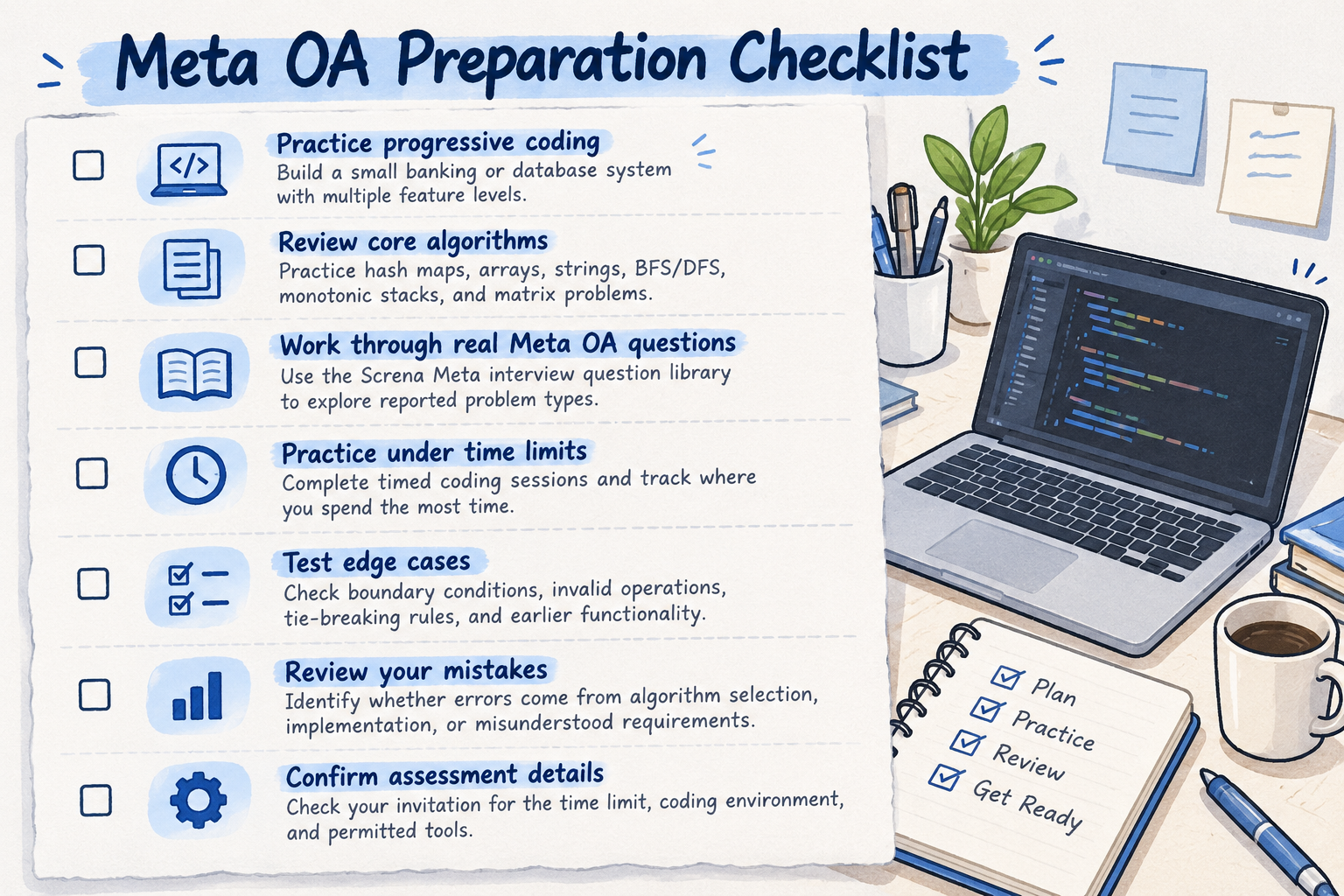
Choose a small project and extend it through several connected requirements. A banking exercise might begin with basic account operations before introducing rankings and scheduled payments. A database exercise could start with record storage and progress toward filtering, timestamps, and expiration.
The important practice is not memorizing one banking or database solution. It is learning how to extend an implementation while preserving the behavior already required. After each new feature, check that earlier operations still work and that the data model supports the next stage.
Review Core Algorithms and Data Structures
Independent coding questions require a broader review. Based on the reported examples, relevant topics include hash maps, string and array operations, BFS and DFS, monotonic stacks, matrix transformations, simulation, and numerical comparisons.
Rather than treating each topic as a checklist item, practice solving unfamiliar variations from written specifications. Pay attention to how small changes in constraints or output rules affect the implementation. This helps develop the flexibility needed when several unrelated questions appear in one session.
Build a Time Management and Testing Strategy
Use timed sessions to identify whether most of your time goes into understanding requirements, implementation, or debugging. For progressive coding, reserve time to verify earlier functionality as new features are added. For independent questions, practice moving between problems without spending too long on one approach that is not working.
Testing should cover ordinary inputs, boundary conditions, and invalid operations. Build this habit into the coding process rather than leaving every check until the end. The time limit used for practice can be adjusted to match the instructions in the candidate's actual assessment invitation.
Use Real Meta OA Questions to Guide Your Practice
The Meta interview questions and experiences library on Screna provides a starting point for identifying reported question types. Candidates can select representative banking, database, and independent algorithm problems, reconstruct the available requirements, and use them as practice exercises.
After solving a problem, review why tests failed and whether the issue came from the algorithm, state handling, or a misunderstood requirement. Screna's AI Mock Interviews can complement this process through role- and job-description-based technical Q&A, particularly for explaining concepts and reasoning. It is not a substitute for writing and testing code in a timed programming environment.
7. Meta OA FAQ
What Is the Passing Score for the Meta OA?
The reviewed experiences do not establish a single passing threshold. A Meta banking OA report describes a passing result despite incomplete test coverage, while the banking OA experience discussed in Section 5 includes the candidate's belief that nearly complete coverage was necessary. These accounts do not provide enough evidence to calculate a reliable cutoff, so candidates should focus on maximizing correctness rather than targeting an assumed score.
How Long Is the Meta Online Assessment?
One Meta banking OA report describes a 90-minute assessment with four progressive levels. The reviewed experiences do not establish a standard duration for every Meta OA, so candidates should refer to their own assessment invitation for the applicable time limit.
Is the Meta OA Always Conducted on CodeSignal?
Three of the 18 traditional Meta coding reports explicitly mention CodeSignal. Other candidate experiences describe different coding formats, including independent questions and AI-assisted environments, without necessarily confirming the assessment platform. These reports do not establish how widely CodeSignal is used across Meta's assessments. Candidates should check their invitation for the assessment environment and permitted tools.