Interview Prep
Amazon AI-Assisted OA 2026: 24 Real Reports & Repo Tasks
Pian Yang · Marketing Specialist ·

Preparing for the Amazon SDE online assessment in 2026 may involve challenges beyond familiar LeetCode-style problems. Candidates who are comfortable solving algorithm questions can still find themselves underprepared when asked to work inside an unfamiliar codebase with AI assistance.
Unlike traditional coding interviews, these tasks are less familiar to many applicants, and the available information about their structure and evaluation is limited. To help candidates prepare, Screna reviewed 24 firsthand Amazon AI-assisted OA experiences from 2026. This guide brings together reported formats, real coding tasks, test results, and practical preparation strategies.
1. Amazon AI-Assisted Coding Assessment 2026 at a Glance: Quick Answer
The Amazon AI-assisted coding assessment is a candidate-reported component of some Amazon online assessments in which applicants use an AI coding assistant while working on an existing software project. Candidates may need to investigate application issues, modify code, or complete functionality.
What should candidates know before taking it?
- Question types: Tasks may involve repository debugging, feature implementation, or AI-generated code that needs further correction.
- AI assistance: Some assessment environments provide an integrated AI assistant, but its capabilities and reliability can vary.
- Assessment format: AI-assisted tasks may appear alongside traditional DSA questions. The exact setup differs across candidate reports.
- Preparation: Practice navigating unfamiliar repositories, tracing bugs, checking test results, and validating AI-generated suggestions.
These details come from candidate experiences shared on Screna, not a universal assessment specification or an official Amazon scoring policy.
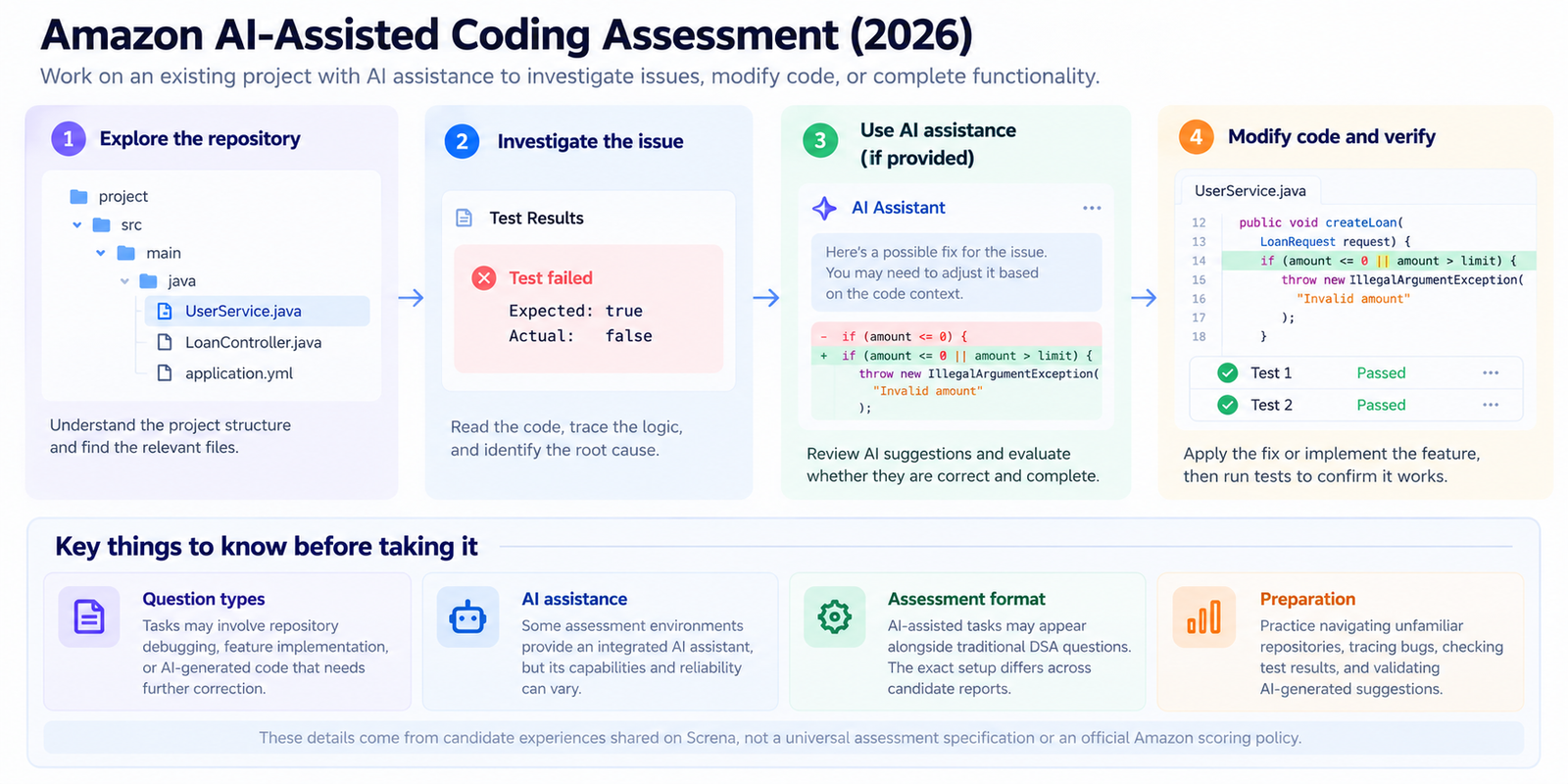
*Illustrative example based on candidate-reported task types. Not an actual Amazon assessment screenshot.
2. Amazon AI-Assisted Coding Assessment Format
Candidate reports from 2026 describe several versions of Amazon's AI-assisted coding tasks, with differences in question structure, time limits, and development environments. While Amazon's official SDE online assessment guidance explains the broader OA process, the AI-assisted task details discussed here come from firsthand experiences shared on Screna.
What Is the Amazon AI-Assisted Coding Assessment?
In a repository-based task, applicants typically start with an existing application rather than a blank coding editor. They need to explore the project structure, identify the relevant files, and trace how the affected functionality works before making changes.
For example, a failing test may point to an issue in a controller, service, or database operation. Applicants must determine the root cause, apply a targeted fix, and check whether the change resolves the failure without affecting other functionality. An AI assistant may help with parts of this process, but applicants still need to evaluate its suggestions and verify the results.
How Does AI-Assisted Coding Differ from Traditional Amazon OA Questions?
The main difference is the starting point. Traditional coding questions ask applicants to develop a solution to a standalone problem, while repository-based tasks require them to investigate and modify an existing application. The comparison below summarizes how these workflows differ.
| Traditional Amazon OA Coding | Reported AI-Assisted Coding Tasks |
|---|---|
| Solve an algorithmic problem | Debug or extend an existing application |
| Write a solution from scratch | Navigate and modify existing code |
| Apply data structures and algorithms | Investigate application logic and dependencies |
| Run tests against a new solution | Diagnose failures, apply fixes, and rerun tests |
| Primarily use a coding editor | May work with an integrated AI assistant |
What Do Reports on Screna Say About the AI Coding Format?
Across the 24 reviewed Amazon AI-assisted OA reports, several patterns emerge, although the exact tasks and assessment environments differ.
1. Traditional coding and AI-assisted tasks can appear together.
More than ten reports on Screna describe a combination of a DSA problem and an AI-assisted repository task. In one Amazon SDE I OA experience, the applicant passed 15/15 test cases on the first coding question but only 1/6 on the second, AI-assisted task. This distinction matters when preparing for the Amazon SDE OA 2026: strong algorithm skills may not fully prepare applicants for debugging an unfamiliar application
2. Time limits and assessment platforms vary across reports.
Two reports on Screna explicitly mention a 60-minute AI-assisted task. HackerRank also appears in some experiences, including an Amazon movie watchlist debugging report and an Amazon HackerRank OA report describing repository navigation. These observations do not establish a universal duration or platform for every applicant.
3. AI assistance may have practical limitations.
Some applicants reported restrictions on AI access to project files or encountered tool errors during their assessments. These experiences suggest that AI assistance may vary across assessment environments.
4. The assignment may involve more than fixing bugs.
Although repository debugging appears frequently, some applicants describe implementing features or generating code through prompts before debugging the result. The reported Amazon AI coding assessment format therefore calls for a broader set of skills: reading existing code, identifying root causes, making targeted changes, and validating whether those changes work.
5. Framework selection may be part of the assessment.
One candidate-reported collection describes an assessment format in which applicants choose from four backend frameworks, including Django and Spring Boot, before starting. Once selected, the framework cannot be changed. This is a reported variation rather than a confirmed rule across all Amazon assessments.
3. Real Amazon AI-Assisted Coding Assessment Questions
The 2026 Amazon OA experiences on Screna include repository tasks involving loan processing, issue tracking, movie watchlists, and backend services. These examples illustrate the types of problems applicants encountered rather than a confirmed or exhaustive Amazon question bank.
Loan Application Repository Debugging
Loan processing is one of the repository debugging scenarios documented in a June 2026 Amazon loan application experience. The existing application contained three stated problems:
- Users could not create a new loan.
- Users could not view their existing loans.
- Users could fund a loan even when their available balance was insufficient.
The applicant reported fixing the three listed issues but encountered an additional problem related to the repayment flow. A similar loan scenario is also described in an Amazon repository debugging scenario collection, which contains several task examples within a single report.
Jira-Like Application Debugging
Comment functionality was the focus of a May 2026 Amazon Jira-like debugging experience. In this project-management application, comments did not behave correctly after being created or updated. The applicant initially investigated the interface before identifying problems in the application's backend logic.
The task also required the API to follow the README contract, including correct status codes, error messages, and authorization checks. The applicant specifically reported difficulties with 401 and 403 responses. Solving the task therefore involved tracing the comment functionality and checking whether the API behavior matched the documented requirements.
Spring Boot Application Debugging
Spring Boot appears in multiple Amazon AI-assisted coding experiences. One Amazon Spring Boot OA experience involved debugging an existing Java application, with the applicant passing one of six tests. Another Spring Boot repository debugging experience involved six introduced bugs, four of which the applicant reported fixing despite repeated AI tool failures. These accounts show how repository debugging can involve both application-level issues and practical difficulties with the provided development tools.
Movie Watchlist Application Debugging
Movie-related tasks on Screna involve both watchlist management and personalized recommendations. The May 2026 Amazon movie watchlist assessment featured a full-stack application with six failing unit tests. The reported requirements included:
- Adding movies to a watchlist and handling duplicates.
- Deleting movies from an existing watchlist.
- Handling requests for watchlists that do not exist.
- Adding multiple movies and then removing them individually.
The applicant encountered problems involving application behavior and data persistence. A separate Amazon movie recommendations debugging experience involved a recommendation feature that remained empty after users watched and rated movies. The linked reports provide more detail about the specific failures and the applicants' approaches.
Other Backend Debugging Examples: Node.js and Django
Node.js and Django also appear in the reported Amazon AI coding assessment questions, with one explicit experience for each framework. In the June 2026 Amazon Node.js debugging experience, the candidate resolved controller and routing issues in under 40 minutes and reported a Pass outcome. They credited their familiarity with Node.js and noted that Amazon's practice assessment closely resembled the actual task. By contrast, an April 2026 Amazon Django debugging experience focused on comment-related functionality in an unfamiliar Django codebase. The candidate struggled with the framework and reported passing no tests. These are individual experiences and do not establish how frequently either framework appears in Amazon assessments.
4. Common Challenges in Amazon AI-Assisted Coding Assessments
The candidate experiences discussed above reveal several practical challenges that can affect performance during repository-based coding tasks.
Understanding an Unfamiliar Codebase
One of the main challenges is understanding an unfamiliar codebase under time pressure. As the Jira-like, Django, and Node.js experiences discussed earlier show, applicants may need to navigate an existing project, identify relevant files, and understand how different components interact before making changes. Familiarity with the underlying framework can make this process easier, while limited experience with a particular technology may slow down debugging. Repository-based tasks require applicants to spend part of their assessment time understanding the application itself.
AI Assistant Limitations and IDE Tool Failures
AI assistance can be useful, but the reported experiences also reveal its limitations. Some applicants encountered assistants that could access only the currently open file, while others experienced tool errors or suggestions that did not resolve the underlying problem. The Spring Boot debugging experience mentioned earlier shows how unreliable AI tools can disrupt the workflow and leave applicants to investigate issues independently. These limitations can be particularly challenging when debugging requires understanding code across multiple files.
Debugging Failures, Test Cases, and Edge Cases
Fixing the main issue does not always mean that an application will pass every test. The loan application and movie watchlist examples discussed earlier involved related functionality and edge cases that made debugging more complicated than addressing a single visible bug. Applicants may need to determine whether a failure comes from the original issue, an incomplete fix, or another part of the application. This helps explain why repository debugging can remain difficult even after the most obvious problem appears to be resolved.
Managing Time During Repository Debugging
Time pressure affects every stage of repository debugging, from understanding the project to applying changes and validating results. Some reports on Screna explicitly mention a 60-minute AI-assisted task, but the available experiences do not establish a universal time limit. Applicants must decide how much time to spend exploring the codebase, investigating failures, and checking their fixes. Unexpected issues or unfamiliar frameworks can make this balance harder, especially when there is limited time to revisit unsuccessful changes.
5. Amazon AI-Assisted Coding Test Case Results
How many test cases do candidates pass on Amazon's repository-based coding tasks? Among the reports reviewed on Screna, 12 included explicit results out of six test cases. Seven specifically mentioned AI assistance, while five described repository debugging without confirming whether an AI assistant was available. To avoid treating these as identical assessment formats, the results are separated into two groups below.
Reported Test Case Results: AI-Assisted vs. AI Not Specified
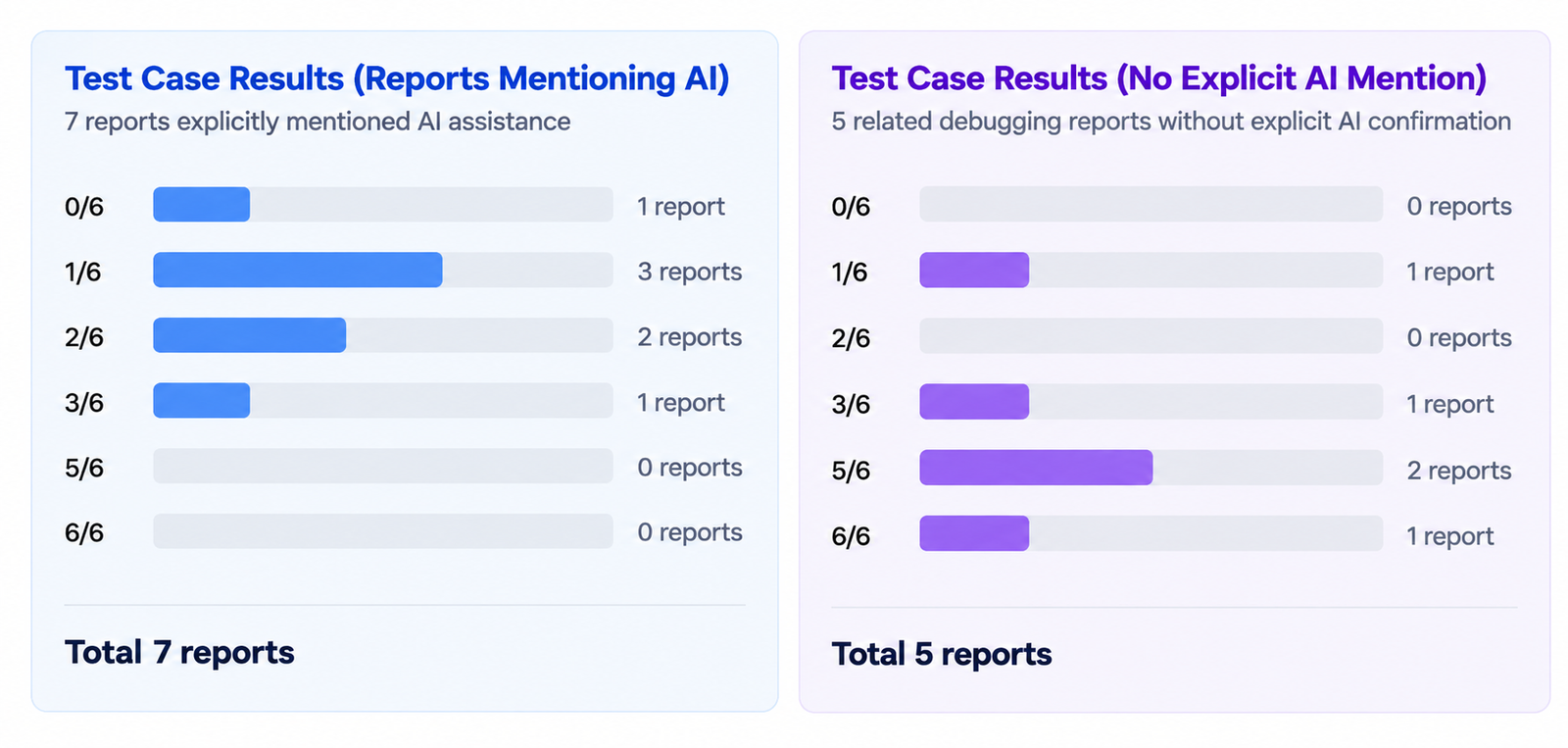
Among the seven reports explicitly mentioning AI assistance, all candidates reported passing three or fewer of the six test cases. The higher scores of 5/6 and 6/6 appeared only in the five repository debugging reports that did not explicitly mention AI assistance.
This difference is worth noting, but it should not be interpreted as evidence that AI-assisted tasks are inherently more difficult. The sample is small, and the reports may involve different tasks, assessment environments, and candidate backgrounds.
What These Results Can and Cannot Tell Us
Test case results indicate how many checks an applicant passed on a particular task, but they do not explain why the remaining tests failed. A low score might reflect unfinished functionality, an unresolved bug, or a problem that only appears under certain test conditions.
The reports do not establish an official Amazon AI coding assessment passing score or cutoff. Because assessment requirements may vary and verified hiring outcomes are limited, these test case results cannot reliably predict whether a candidate will advance to the next stage.
6. How to Prepare for Amazon AI-Assisted Coding Assessment
Preparing for repository-based coding tasks involves more than practicing standalone algorithm questions. Based on the 2026 candidate experiences shared on Screna, applicants should also become comfortable reading existing applications, investigating bugs, working with AI coding tools, and verifying their changes. The following strategies focus on the repository debugging skills reflected in those reports rather than an official Amazon preparation checklist.
Practice Reading and Navigating Existing Codebases
Start by exploring small, unfamiliar projects instead of building every application from scratch. Choose an existing repository in a framework such as Spring Boot, Node.js, or Django, then identify its entry points, routes, services, data models, and tests. Try tracing a single feature from the incoming request to the final response without immediately modifying the code.
Use the practice assessment if Amazon provides one. A candidate who reported passing a Node.js debugging OA noted that Amazon's practice task closely resembled the actual assessment. If your invitation includes a practice link, use it to become familiar with the workflow and development environment. If your assessment requires choosing a backend framework, select the one you can navigate and debug most confidently. One reported assessment format did not allow candidates to change frameworks after making their selection.
Practice Finding and Fixing Bugs
Once you can navigate an existing project, practice debugging applications with broken functionality. Look for small open-source projects with reproducible issues, or introduce controlled bugs into a working application and attempt to identify them without referring to the original implementation. Focus on reproducing the failure, tracing the relevant code path, and identifying the underlying cause before making changes. Practicing this process is particularly useful for the Amazon AI-assisted coding questions described earlier, where applicants were asked to repair existing features rather than implement standalone algorithms.
Learn to Work Effectively with AI Coding Assistants
Practice using an AI coding assistant as a debugging aid rather than relying on it to solve the entire task. Instead of asking for a complete fix immediately, provide a specific error message, explain the expected behavior, or ask the assistant to review a particular function. Compare its suggestions with the actual code and test results before applying them. Since some Amazon OA reports describe limited file access and tool failures, it is also worth practicing without AI assistance. Applicants should be able to continue investigating a problem even when the assistant lacks context or produces an incorrect suggestion.
Validate Fixes with Tests and Edge Cases
Treat verification as part of the debugging process, not something to do only after all changes are complete. Run the available tests before modifying the application to establish which behaviors are failing, then rerun relevant tests after each fix. Check whether the change affects related functionality and consider edge cases such as duplicate inputs, missing records, invalid values, or unexpected application states. A fix that resolves the most visible error may still leave other tests failing, so practice using test results to guide further investigation rather than assuming the problem is solved.
Practice Debugging Under Time Constraints
Set a fixed time limit for debugging an unfamiliar repository to simulate assessment conditions. During each practice session, allocate time to understand the project, reproduce reported bugs, implement fixes, and run tests before the deadline. Afterward, review which steps took the longest, what remained unresolved, and how you could improve your workflow. For interview-style preparation, Screna AI Mock can help applicants practice explaining debugging decisions and technical tradeoffs through role-specific questions, although it does not reproduce the repository editing environment of the assessment.
7. More Amazon AI-Assisted Coding Reports on Screna
Additional candidate reports on Screna cover backend API debugging, feature implementation, and variations in AI coding tools that extend beyond the examples discussed earlier.
Additional Repository Debugging Reports
Beyond the loan application, Jira-like application, and movie watchlist examples discussed earlier, other Amazon candidates have reported debugging tasks involving backend APIs, application functionality, and existing project code. One Amazon search API debugging experience describes a backend issue alongside difficulties with the browser-based debugging environment. Another Amazon feature implementation experience provides an example of completing functionality within an existing application. These reports offer further context on the range of practical coding tasks candidates have encountered.
Additional OA Format and AI Tool Experiences
Assessment environments and AI tool behavior also differed across individual candidate accounts. An Amazon HackerRank OA experience discusses navigating an AI-assisted repository task, while another Amazon OA experience involving repeated AI output describes a tool issue that consumed a substantial portion of the assessment time. A separate Amazon AI prompting and debugging experience reports a different format involving prompt writing, AI-generated code, and debugging.
For more firsthand experiences across different roles and assessment stages, explore the Amazon interview questions and candidate reports on Screna.