Interview Prep
6 Roblox OA Reports 2026: SWE vs DS Questions & Format
Qian Zhou · Marle ·
Preparing for the Roblox OA can be confusing, especially when candidate experiences describe very different assessments. Some software engineering applicants encounter factory simulations and Mars-themed programming games, while Data Scientist candidates report statistics, machine learning, and technical judgment questions. Even candidates applying for similar roles may describe different challenges.
To make sense of these differences, we reviewed six Roblox online assessment reports shared on Screna between May and August 2026. This guide breaks down the actual questions candidates encountered, the difficulties they reported, and how to prepare for the assessment based on your role.
1. Quick Answer: What to Expect in the Roblox OA 2026
Based on six Roblox OA candidate reports from May to August 2026, the assessment format and question types varied between Software Engineer and Data Scientist roles.
| Category | Software Engineer | Data Scientist |
|---|---|---|
| Assessment Forma | Game-based simulations and coding assessments | Statistical and ML programming, technical situational judgment |
| Reported Questions | Factory Simulation, Mars-Themed Block Coding, Matrix Questions | Logistic Regression, Sample Size Calculation, Difference-in-Differences, Bayesian Reasoning |
| Reported Duration | Over 2 hours for game-based tasks, with some candidates reporting an additional ~50-minute coding section | One candidate reported a 90-minute assessment |
| Common Challenges | Unfamiliar game interfaces, time-consuming simulations, matrix optimization | Feature ranking, input formats, statistical assumptions, implementation details |
Note: These findings are based on six candidate-reported Roblox OA experiences from May–August 2026. They reflect reported question types and durations rather than a standardized assessment format.
2. Roblox SWE OA Questions and Game-Based Assessments
The Roblox SWE OA can look quite different from a typical software engineering online assessment. Based on three candidate reports from June through August 2026, the process included game-based simulations alongside more conventional coding challenges. Rather than focusing entirely on algorithms, the game-based portion asked candidates to solve problems through interactive environments. The exact format may vary. The reports describe factory simulations, Mars-themed programming tasks, and matrix-based coding questions, but they do not establish a single assessment format for every Roblox SWE applicant
Factory Simulation and Mars-Themed Block Coding
One July 2026 candidate described two simulation tasks in their Roblox software engineer OA experience.
- The first involved navigating and managing a factory environment. Unlike a standard coding question with a clearly defined input and output, the factory simulation required the candidate to work within an interactive setting. The candidate reported spending considerable time on this task without feeling confident about the result.
- The second task involved controlling a drone on Mars. Candidates had to create functions to guide the drone across maps and then apply those functions under test conditions. The same candidate found this portion considerably harder than the conventional coding assessment.
A separate June 2026 Roblox SWE OA report described Mars-themed mini-games using a block-based programming interface. The candidate spent more than two hours on the game-based portion and found the unfamiliar controls challenging.
These experiences highlight an important distinction: the difficulty of a Roblox game-based assessment may come from understanding the simulation and working with its interface, not just from knowing the underlying programming concepts.
Matrix and Coding Assessment Questions
The traditional Roblox coding assessment was more familiar to the candidates who discussed both coding and simulation tasks.
In the July 2026 report, the candidate described two matrix-related questions involving matrix traversal or manipulation. The second also required improving an initially less efficient solution. The candidate found this coding portion easier than the simulations. The report identified CodeSignal as the platform used for the coding assessment, although this does not establish that every Roblox SWE OA uses the same platform.
The June report also mentioned a conventional coding section lasting approximately 50 minutes after the game-based tasks. An August 2026 junior SWE candidate similarly reported a coding challenge after nearly three hours of game-style assessments, describing coding as the more manageable part of the experience.
Across these reports, two observations stand out. Matrix-related coding questions appeared in the July candidate's assessment, while multiple SWE candidates described difficulties with the less familiar simulation tasks. These experiences suggest that preparing for the Roblox SWE OA involves both conventional algorithmic problem-solving and adapting to interactive, game-based challenges.
3. Roblox Data Scientist OA Questions
The Roblox Data Scientist OA follows a different pattern from the game-based SWE assessments described above. Three candidate reports from May and June 2026 focus on statistics, machine learning, data manipulation, and applied analytical reasoning. The reported questions go beyond choosing the correct statistical method. Candidates also had to translate mathematical concepts into working code, handle specific input formats, and follow detailed output requirements.
Logistic Regression and Feature Selection
Logistic regression appeared in two Roblox Data Scientist OA reports from May 2026. Both described a feature-selection problem involving logistic regression coefficients.
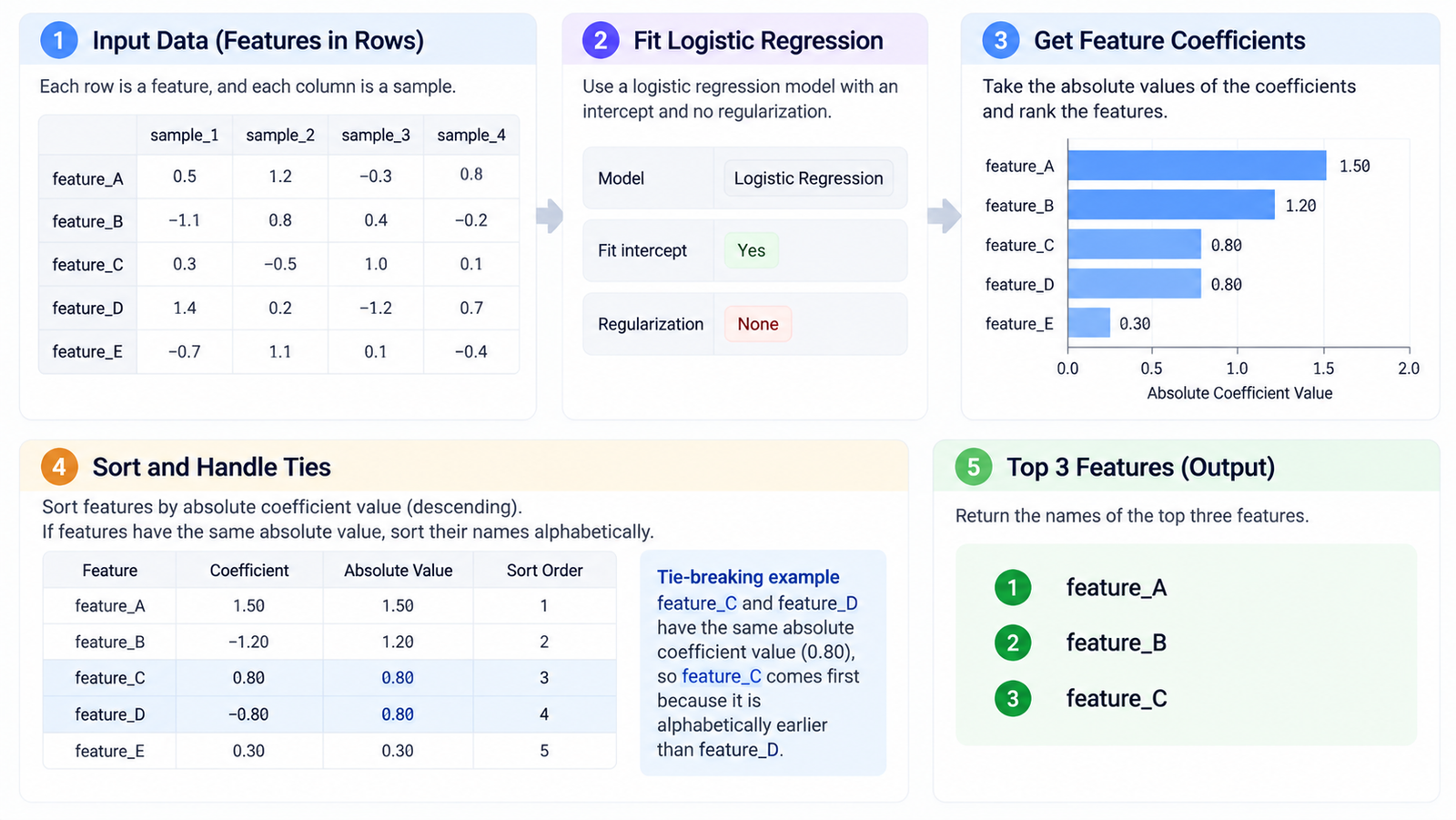
The reported task required candidates to fit a logistic regression model with an intercept and no regularization, then return the top three features ranked by the absolute values of their coefficients. When features had equal absolute coefficient values, their names needed to be sorted alphabetically. Another important detail was the input layout: features were arranged in rows rather than the more familiar format of samples in rows and features in columns.
These details matter because a solution can apply the correct statistical concept and still fail if it mishandles the data orientation, model configuration, or sorting requirements.
The two reports describe closely matching problem requirements and appear to refer to the same underlying question type, although they do not establish that the candidates received identical assessment versions. See the May 2026 Roblox Data Scientist OA report for the reported feature-selection details.
Statistics, Causal Inference and Bayesian Reasoning
A separate May 2026 Data Scientist assessment report described four questions covering statistical testing, causal inference, probability, and machine learning:
- Sample Size Calculation: Calculate the minimum per-group sample size for a two-sided, two-sample z-test using a historical sample, significance level, desired statistical power, and minimum detectable effect.
- Difference-in-Differences: Implement a DiD estimator using period labels, group indicators, and outcomes. When multiple pre-treatment periods are available, validate the parallel trends assumption against a specified threshold.
- Bayesian Reasoning: Calculate the posterior probability P(A|B) from P(A), P(B|A), and P(B|not A) using Bayes' theorem.
- Logistic Regression: Fit a model and return the top three features by absolute coefficient value, using alphabetical order to break ties.
Although these questions test different statistical concepts, they share a practical requirement: translating mathematical reasoning into accurate implementations while following the specified input and output rules.
Pandas Pipeline and Situational Judgment
A June 2026 Roblox Data Scientist OA experience described a situational judgment question involving a Pandas data-processing pipeline. In the reported scenario, the pipeline was failing hidden tests, a teammate proposed an unverified fix, and the candidate had to consider how to respond while meeting a deadline.
Rather than implementing a separate Pandas coding task, the candidate was asked to evaluate possible actions in a technical workplace situation. The question therefore combined a data-processing context with judgment about debugging, collaboration, and prioritization.
This example differs from the four-question statistical programming assessment described in May. The three Data Scientist reports show variation in question types, but do not establish a standard combination of technical and situational judgment questions for every applicant.
4. Roblox OA Difficulty, Time Limits and Common Challenges
How difficult is the Roblox OA? The six candidate reports describe different challenges depending on the role and assessment component. Some SWE candidates found the game-based simulations more difficult than conventional coding questions, while Data Scientist reports highlighted detailed implementation requirements and time management.
Game-based assessments can take longer than expected. One June 2026 SWE candidate reported spending more than two hours on Mars-themed block-coding games before moving to an approximately 50-minute coding section. An August candidate described nearly three hours of game-based tasks. These are candidate-reported durations rather than official time limits.
Unfamiliar interfaces create additional difficulty. The June SWE candidate struggled with the block-based programming controls, while a July candidate found the Mars drone simulation especially demanding. Knowing how to code does not automatically translate into familiarity with a visual programming environment.
Small implementation details matter in DS questions. The reported logistic regression task required attention to feature orientation, model configuration, absolute coefficient values, and alphabetical tie-breaking. The Difference-in-Differences question also included a conditional parallel trends validation requirement. These details could affect whether an otherwise reasonable solution produces the expected result.
Time pressure also appears in Data Scientist assessments. One June DS candidate reported a 90-minute assessment, while a May report described four technical questions. The available reports do not establish that these candidates received the same assessment format or platform.
Technical setup can affect the experience. An August SWE candidate described repeated difficulties with facial identity verification before starting the assessment, along with high computer resource usage. The report documents a verification issue but does not establish whether the assessment was continuously proctored.
These experiences provide useful examples of Roblox OA challenges, but they should not be treated as universal assessment rules. Candidates should distinguish the timing, format, and verification requirements reported by others from the instructions provided for their own assessment.
5. How to Prepare for the Roblox OA
The most useful Roblox OA preparation strategy is role-specific.
Roblox SWE OA Preparation
Start by getting comfortable with the game mechanics. Roblox has described practice experiences such as Kaiju Cats, which introduces mechanics associated with its Robots and Factories assessments, and Coding Cookies, which helps candidates practice the block-coding interface associated with Outpost: Mars. These resources are particularly relevant to the unfamiliar controls and simulation challenges described in the SWE reports.
For the coding portion, prioritize matrix and two-dimensional array problems. Practice traversing grids, updating elements based on neighboring values, and improving solutions that perform unnecessary repeated work.
A useful preparation sequence is:
- Try Roblox's official practice games to understand the simulation controls.
- Review functions, loops, conditional logic, and reusable instructions for block-based programming.
- Solve matrix and grid problems under timed conditions.
- Practice explaining why a solution works and where its performance could be improved.
The final step is useful beyond the OA itself. Screna AI Mock offers question-and-answer interview practice that can help candidates rehearse technical explanations and problem-solving discussions. It does not reproduce Roblox's game-based assessments or provide an equivalent coding-test environment.
Roblox Data Scientist OA Preparation
For Data Scientist applicants, preparation should center on implementing familiar statistical ideas accurately. Based on the reported questions, four areas are particularly useful:
- Logistic Regression and Feature Selection: Practice fitting models with specified configurations, extracting coefficients, ranking features by absolute value, handling ties, and checking input orientation.
- Statistical Programming: Work through sample size calculations, Difference-in-Differences estimation, parallel trends validation, and Bayesian probability in Python.
- Pandas and Data Processing: Review filtering, grouping, joining, sorting, and transforming data. Also practice reasoning through debugging scenarios, including how to respond when a proposed fix has not been verified.
- Output Validation and Time Management: Check edge cases, confirm the required data structure, and reread ordering or tie-breaking rules before submitting.
Candidates preparing for later technical interviews can also use Screna AI Mock to practice explaining statistical choices, model assumptions, and analytical trade-offs in a question-and-answer setting. This complements coding practice rather than replacing it.
6. Roblox OA FAQ
What is the Roblox OA and what questions are asked for SWE roles?
The Roblox OA is an online assessment used in Roblox's hiring process to evaluate skills such as problem-solving and decision-making. Roblox's early-career guidance describes game-based and coding assessments. For SWE candidates, 2026 reports include factory simulations, Mars-themed block coding, and matrix-related coding questions.
What questions are asked in the Roblox Data Scientist OA?
Reported Roblox Data Scientist OA questions include logistic regression feature selection, sample size calculation, Difference-in-Differences, Bayesian reasoning, and a situational judgment scenario involving a Pandas pipeline with failing hidden tests.
How long is the Roblox OA?
SWE candidates reported spending over two hours, sometimes nearly three, on game-based assessments, with some completing an additional coding section lasting approximately 50 minutes. One Data Scientist candidate reported a 90-minute assessment.
Is the Roblox OA proctored?
The available reports do not establish a consistent proctoring policy. One August 2026 SWE candidate described facial identity verification before the assessment, but identity verification alone does not confirm continuous monitoring.
Does the Roblox OA include a coding assessment?
Coding appeared in the reported SWE and Data Scientist assessments. SWE candidates described matrix-related problems, while Data Scientist candidates reported statistical programming and machine learning questions. The combination of assessment components varied across the available reports.
How should I prepare for the Roblox game-based assessment?
Start with Roblox's official practice resources to become familiar with the controls and simulation mechanics. For SWE roles, combine this with matrix and algorithm practice. Data Scientist candidates should focus on Python, statistical programming, and interpreting detailed technical requirements.
Note: These findings are based on six candidate-reported Roblox OA experiences from May–August 2026. Assessment formats, timing, platforms, and verification requirements may vary by role and hiring cycle.