Interview Prep
21 Google Online Assessment Reports 2026, Including AI Tasks
QianZhou · Marketing Specialist ·

Preparing for a Google online assessment in 2026? The challenge is knowing which format to expect. Some candidates receive traditional coding problems, while others encounter AI-assisted debugging tasks or work style assessments.
To understand these differences, we reviewed 21 Google SWE interview reports labeled as OA on Screna, covering April through August 2026. This guide breaks down the reported formats, actual questions, and preparation strategies, while distinguishing confirmed OA experiences from coding rounds whose exact stage was not specified.
1. Quick Answer: What to Expect from the Google Online Assessment in 2026
Based on the 21 Google SWE reports reviewed, here's what candidates encountered:
| Assessment Aspect | Findings from Candidate Reports |
|---|---|
| Time and platform | Five reports mentioned a 90-minute assessment, some with two coding questions. Two referenced HackerRank. |
| Coding questions | Reported problems included Two-Digit Common Numbers, Coin Collection, Trie operations, dynamic programming, and email token verification. The Two-Digit Common Numbers problem appeared twice, while Coin Collection had two different rule sets. |
| AI-assisted coding | Three reports described variations of the same feature rollout task, involving dependency cycle detection, debugging, and code verification with a built-in AI assistant. |
| Non-coding assessments | Four reports involved work style questionnaires or situational judgment questions, including a reported 60-item assessment. |
| Differences by level | The sample included 3 Junior and 18 Intermediate SWE reports. Junior experiences mainly described traditional coding, while Intermediate reports covered a broader range of assessment formats. |
Bottom line: There is no single Google OA format established by these reports. Prepare for algorithm questions and implementation accuracy, but also review debugging, unit testing, and non-coding assessment formats. Your invitation remains the source for your specific test requirements.
2. Google Online Assessment Format and Overview
Google's online assessment can take different forms depending on the assessment assigned. This article reviews 21 Google Software Engineer interview reports labeled as OA on Screna, covering April through August 2026. Some reports describe coding rounds without explicitly confirming the assessment stage, so individual questions are identified by their reported context.
1. What Is the Google Online Assessment?
The Google OA is an assessment used during the hiring process. Depending on the format, candidates may solve algorithm problems, debug existing code, or answer questions about workplace decisions and working preferences.
2. How Many Questions and How Much Time?
Five of the 21 reports mentioned a 90-minute assessment, with some describing two coding questions. Two reports referenced HackerRank. These are candidate-reported formats, not universal requirements. Your assessment invitation is the best source for the exact time limit, platform, and instructions. You can also explore Google online assessment questions shared by other candidates.
3. Coding vs. Non-Coding Assessments
The reports cover three main types of assessments:
- Traditional coding: Algorithm and data structure problems involving arrays, strings, tries, and dynamic programming.
- AI-assisted coding: Tasks involving existing code, feature dependencies, debugging, and code verification.
- Non-coding assessments: Work style questionnaires and situational judgment questions involving workplace scenarios.
Four reports described non-coding assessments.
4. How Does Google OA Vary by Level?
The 21 reports include 3 Junior and 18 Intermediate SWE experiences, with some differences in assessment formats.
- Junior candidates mainly reported traditional coding problems, such as Two-Digit Common Numbers and Coin Collection, focusing on algorithmic reasoning and implementation. Some described two coding questions in 90 minutes.
- Intermediate candidates reported a broader range of tasks, including traditional algorithms, AI-assisted feature rollout debugging, dependency detection, unit testing, and non-coding assessments such as Work Style and Situational Judgment.
These differences reflect the reported experiences, not Google's official assessment requirements by level.
3. Google Coding Questions Reported in OA-Labeled Experiences
1. Two-Digit Common Numbers
Two Google SWE reports described the same problem: given a list of two-digit numbers, find the largest group sharing at least one digit. One approach checks digits 0 through 9 and counts how many numbers contain each digit. A number such as 11 must only be counted once for digit 1. One Early Career candidate encountered this question in a two-problem, 90-minute assessment.
2. Coin Collection on a One-Dimensional Board
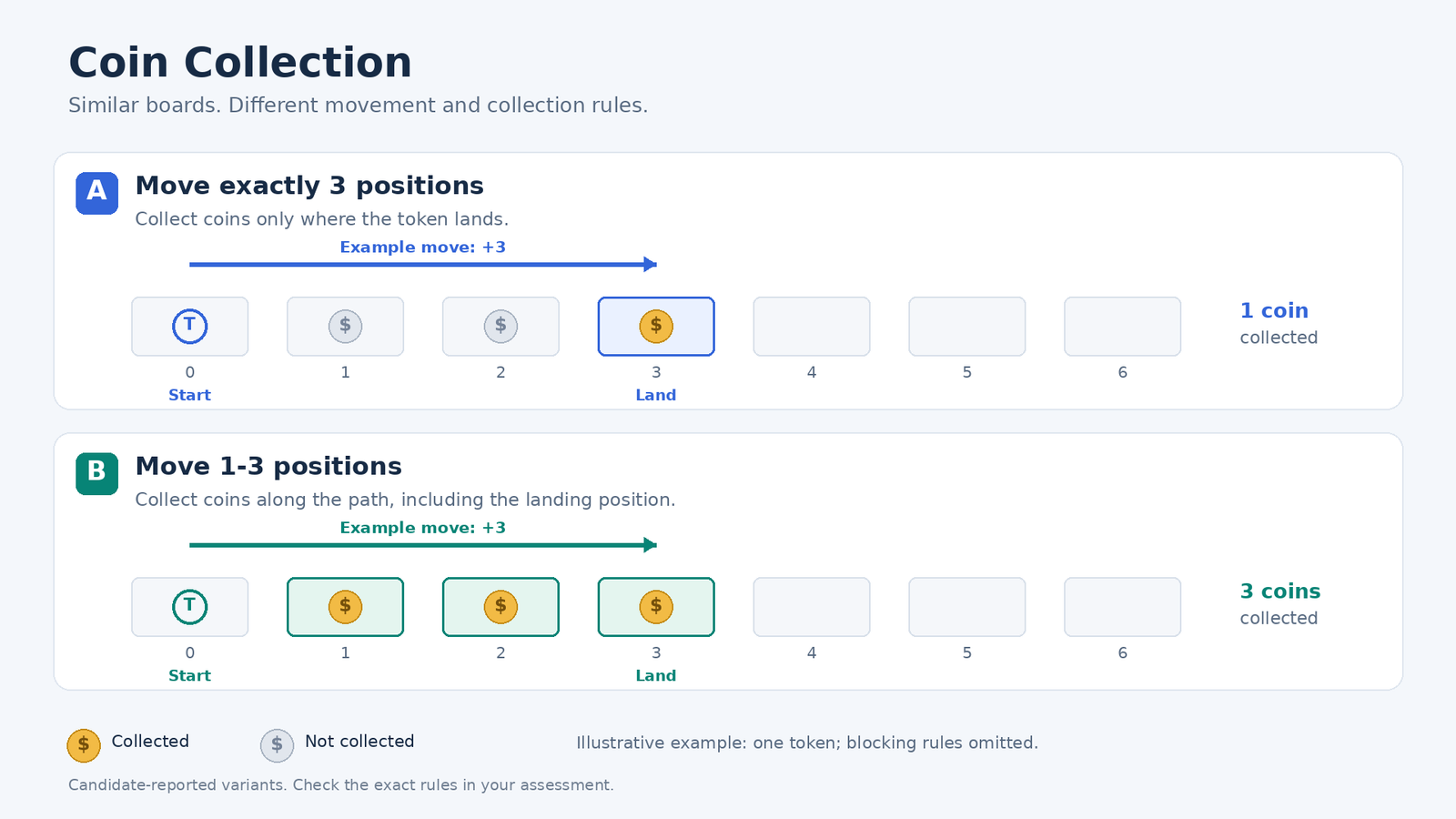
An Early Career coding assessment involved moving tokens across a one-dimensional board to collect coins. In one version, each move shifted a token exactly three positions, and coins were collected only at landing positions. The solution required recognizing that tokens remain within the same modulo-3 position group while accounting for blocking rules. Another report described a different version allowing moves of up to three positions, with coins collected along the path. These are distinct rule sets and should not be treated as identical questions.
3. Trie and Dynamic Programming Questions
Other reports labeled as Google OA included:
- Trie operations such as word insertion, exact-word search, and prefix lookup.
- Dynamic programming problems involved dice-roll probabilities, jump decisions, and profit calculations.
- Jump Game variations also appeared, requiring candidates to choose between collecting rewards and moving forward.
4. Email Token Verification and Other Coding Tasks
One Google HackerRank OA report described an email verification task involving fixed-size text chunks, numeric character mappings, and checksums. The implementation required careful indexing and handling of incomplete chunks. Other reported tasks included prefix-based word filtering and large-integer optimization problems. These Google coding assessment questions and candidate experiences illustrate the importance of understanding constraints and implementing solutions accurately.
4. AI-Assisted Google OA: One Task Reported Three Times
Three Google SWE reports described variations of the same general AI-assisted feature rollout task. Candidates worked with feature configurations, existing code, and dependency rules, with access to a built-in AI assistant These reports do not establish three separate AI assessment formats or indicate that AI assistance is available in every Google OA.
1. Feature Rollout and Dependency Cycle Detection
The task involved determining whether software features could be enabled based on a user's country, operating system version, and dependencies between features. Candidates needed to resolve dependencies in the correct order and detect cycles that could prevent features from being enabled. Two reports also described debugging existing code, including configuration parsing and dependency handling. One Google AI-assisted coding assessment experience highlighted a parser bug and the challenge of identifying all features involved in a dependency cycle.
2. AI Assistance and Unit Testing
All three reports mentioned a built-in AI assistant. One Google feature rollout OA experience described AI as helpful for generating boilerplate code, while debugging still required careful attention. Another Google OA experience involving unit tests mentioned passing unit tests as part of the task.
Although the reports involved similar feature rollout problems, their exact requirements were not necessarily identical. Together, they highlight the importance of understanding existing code, tracing dependencies, and verifying results.
5. Google OA Work Style and Situational Judgment Assessments
Four reports described non-coding assessments, including work style questionnaires and situational judgment questions. These formats focus on workplace situations rather than programming.
1. Work Style Questionnaires
In the reported Google work style assessments, questions concerned working preferences, collaboration, and responses to workplace situations. One Google work style assessment experience described a forced-choice format in which candidates selected between statements about how they preferred to work.
2. Situational Judgment Questions
Situational judgment assessments present workplace scenarios and ask candidates how they would respond. One report described a 60-item situational judgment assessment using a five-point response scale. Other experiences mentioned situations involving integrity, teamwork, and handling uncertainty. The four non-coding reports did not necessarily include both work style and situational judgment questions.
3. What These Assessments Evaluate
Based on the reported questions, these assessments explore workplace judgment, collaboration, and decision-making. The candidate reports do not establish Google's official scoring method or a standard question set. Candidates should focus on understanding each scenario and responding consistently with how they would approach the situation.
6. How to Prepare for Google Online Assessments
Preparation should focus on three areas: algorithm practice, debugging and code verification, and familiarity with non-coding assessments.
1. Practice the Coding Patterns in Real Reports
Prioritize patterns found in the reported questions, including digit counting, array simulation, tries, and dynamic programming. Practice under time limits and pay attention to edge cases. The coin collection examples show how small differences in movement rules can change the solution.
2. Prepare for Debugging and Unit Testing
Practice reading unfamiliar code, identifying bugs, tracing dependencies, and detecting cycles. Write unit tests to check expected behavior and edge cases. If AI assistance is permitted, verify generated code against the task requirements rather than relying on it without review. You can also use Screna AI Mock to practice explaining technical approaches and receive feedback on your answers. It provides interview-style question-and-answer practice rather than a full coding OA simulation.
3. Review Non-Coding Assessment Formats
Become familiar with work style questionnaires and situational judgment questions involving collaboration, integrity, and workplace decisions. Rather than memorizing supposedly correct answers, practice reading scenarios carefully and considering how you would respond.
7. Google Online Assessment FAQ
1. How Long Is the Google OA?
Five of the 21 reviewed reports mentioned 90 minutes. The exact time limit depends on the assessment assigned, so check your invitation.
2. Does Google Use HackerRank?
Some candidates reported using HackerRank. Two of the reviewed reports mentioned the platform, but it is not confirmed for every Google OA.
3. Can You Use AI During the Google OA?
Some assessments may allow it. Three reports described a built-in AI assistant during a feature rollout coding task. Follow your own assessment instructions, as AI assistance is not necessarily permitted in other formats.
4. Are All Google OAs Coding Tests?
No. Four reviewed reports described non-coding assessments, including work style questionnaires and situational judgment questions.